Forest Flora – Chingia australis
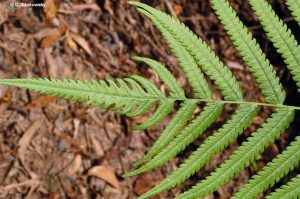
#ForestFlora – Found nowhere else on Earth, Chingia australis is one of Australia’s rarest ferns. It is also the only Australian member of the Chingia genus, making every surviving population an irreplaceable part of north Queensland’s rainforest flora.
This terrestrial, tree-like fern grows from an erect or prostrate trunk that can reach around 60 centimetres tall and 10 centimetres wide. Above it, bright green fronds arch outwards, sometimes stretching up to 2.6 metres long.
Its young fronds reveal an unexpected surprise. While still immature, they are sticky and produce a glandular secretion with a distinctive spicy odour. This secretion can irritate mucous membranes.
Chingia australis is endemic to the Wet Tropics of north Queensland, where its known populations occur across two areas: in and around Wooroonooran National Park, west of Innisfail, and near Daintree National Park.
One of the five populations originally recorded near the Daintree has disappeared since its discovery in May 2000. Because the species is rare and could attract illegal collection, the Queensland Herbarium keeps the exact locations of known populations confidential.
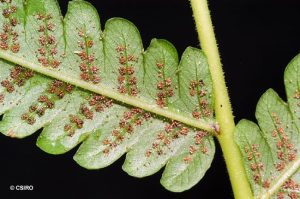
Like all ferns, Chingia australis reproduces through spores rather than flowers or seeds. Small structures called sori grow along the undersides of its fronds, producing large quantities of black spores.
Yet despite producing so many spores, part of its life story remains a mystery. Scientists do not know whether new populations grow from spores carried through the air, or whether spores can remain in the soil for long periods, waiting until the right conditions arrive.
Like many rainforest plants, Chingia australis depends on a delicate balance. It needs the moist conditions created by the surrounding rainforest, but also benefits from natural disturbances such as landslips, floods or fallen trees that expose patches of mineral soil.
These openings create the conditions it needs to establish new plants, making Chingia australis an early successional gap specialist.
Chingia australis is listed as Endangered under both Queensland’s Nature Conservation Act 1992 and the Australian Government’s Environment Protection and Biodiversity Conservation Act 1999.
Its remaining populations face several threats. Rainforest clearing and changes to creeks can remove the moist conditions it needs. Fast-growing weeds can overshadow it, while roadside maintenance may accidentally destroy plants growing along cuttings and pathways. Feral pigs can also eat the ferns and damage their habitat, with the potential to destroy an entire small population.
Protecting the surrounding rainforest is therefore essential. Chingia australis needs more than the patch of soil beneath its fronds. It needs intact rainforest, natural water flows and the cycle of disturbance and renewal that creates rare opportunities for new populations to emerge.
Australia has only one Chingia. Protecting its habitat gives this endangered fern the chance to remain part of the remarkable plant diversity that makes the Wet Tropics so special.
Fun Facts about Chingia australis
- Australia’s Only Chingia: Chingia australis is the only Australian representative of a genus containing around 20 species.
- Found Nowhere Else: The species is endemic to the Wet Tropics of north Queensland.
- A Spicy Surprise: Its sticky young fronds produce a glandular secretion with a distinctive spicy odour.
- A Fern Full of Secrets: Scientists still do not know whether new populations form from airborne spores or long-dormant spores in the soil.
- Waiting for an Opening: Chingia australis responds to gaps where disturbance exposes mineral soil within moist rainforest habitat.
- Fern Country: The Wet Tropics supports Australia’s richest concentration of ferns and fern allies.
References
- Images courtesy of G. Sankowsky and CSIRO
- Department of Climate Change, Energy, the Environment and Water – National recovery plan for the fern Chingia australis
Want more good Rainforest news in your life?
Subscribe to our eNews | Follow us on Instagram | Like us on Facebook | Subscribe to our YouTube channel
Help Protect Rainforests Forever
Donate to Protect Rainforests Forever | Become a Rainforest Guardian | Partnership Options