Trees Are the Answer: Our Daintree Story
What does it take to bring a rainforest back to life?
Sometimes, the answer begins with a single tree. But behind every seedling is something much bigger: a shared commitment to reconnect fragmented landscapes, restore damaged ecosystems and give nature the opportunity to recover.
In the latest edition of Port Douglas Magazine, journalist Jamie Jansen explores the work of Rainforest Rescue, from the remarkable transformation of NightWings to the ambitious vision unfolding across the Daintree Oxbow.
Featuring insights from CEO Branden Barber and Communications Manager Mark Cox, the article reminds us that restoring rainforest isn’t simply about planting trees. It’s about rebuilding the relationships between land, water, wildlife and people—and creating a legacy that will endure for generations.
We’re delighted to share the story.
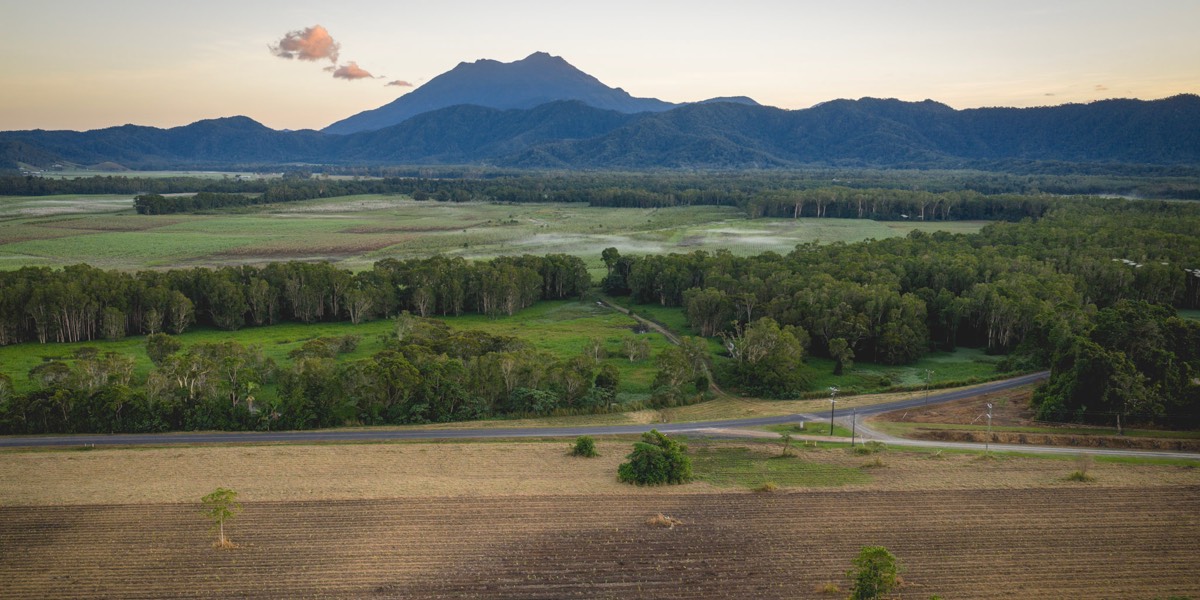
The Oxbow, Lower Daintree, Queensland Australia © Martin Stringer
TREES ARE THE ANSWER
Restoring the Daintree’s Ancient World, One Tree at a Time
Words by Jamie Jansen, Originally published in Port Douglas Magazine, Issue 48
Imagine stepping into a forest so ancient it witnessed the rise and fall of the dinosaurs. At an estimated 180 million years old – older even than the Amazon – this unbroken line of prehistoric green outlasted ice ages and mass extinctions alike.
As you wind along the tropical coastline, you are enveloped by a living ark. It covers a tiny fraction of Australia, yet remains the nation’s most biodiverse hub, home to a third of our frogs, reptiles, and marsupials, and most of our bat and butterfly species.
Look up, and you stand beneath a canopy harbouring 12 of the world’s 19 primitive flowering plant families. Look closer, and you might spot a Bennett’s tree-kangaroo or two vital seed dispersers keeping this forest alive: the Spectacled Flying-fox and the iconic Southern Cassowary – one of the most iconic and threatened large birds on Earth.
Yet behind this lush landscape sits a quieter reality. Historical clearing by European settlers for agriculture and timber severed crucial lowland corridors between the mountains and the sea. Restoring these fragmented private lands is now essential to saving the ancient species that rely on them.
To safeguard this precious rainforest forever, trees are the ultimate answer, and that’s where Rainforest Rescue comes in.
Since 1999, the non-profit has orchestrated a targeted purchase and protect initiative to save biodiverse habitats. To date, Rainforest Rescue has acquired and protected 49 properties nationwide – 48 in the Daintree – preserving over 335 hectares of vulnerable habitat and restoring 65 Ha back to Daintree quality.
Beyond acquisition, their Native Rainforest Nursery at Cow Bay – just north of the Daintree River ferry – grows roughly 180 native plant species, producing up to 150,000 trees annually. When flora is restored, fauna follows. By combining science with hands-on community planting, Rainforest Rescue reconnects fragmented land into a thriving ecosystem.
RESTORATION IN ACTION
The biological recovery on these restored properties is nothing short of incredible, providing clear proof of what happens when degraded land is given a second chance.
For Mark Cox, communications manager at Rainforest Rescue, watching these landscapes heal is the ultimate reward. “When you return to a site a decade later, you aren’t just looking at trees, you’re watching an ecosystem come back to life,” he explains.
A prime example is Nightwings in Wonga Beach, where a former sugarcane farm is now a thriving haven thanks to a decade of planting over 119,000 trees. Spectacled flying-foxes, birds of prey, and young cassowaries have all returned. This effort recently secured Category A status under the Vegetation Management Act 1999 for 18 hectares of the site. This is the highest restriction category under Queensland’s vegetation management framework.
“Seeing species like the cassowary reclaim these spaces proves that habitat restoration truly works,” Mark adds. “When we give nature the chance to heal, the wildlife returns remarkably fast.”
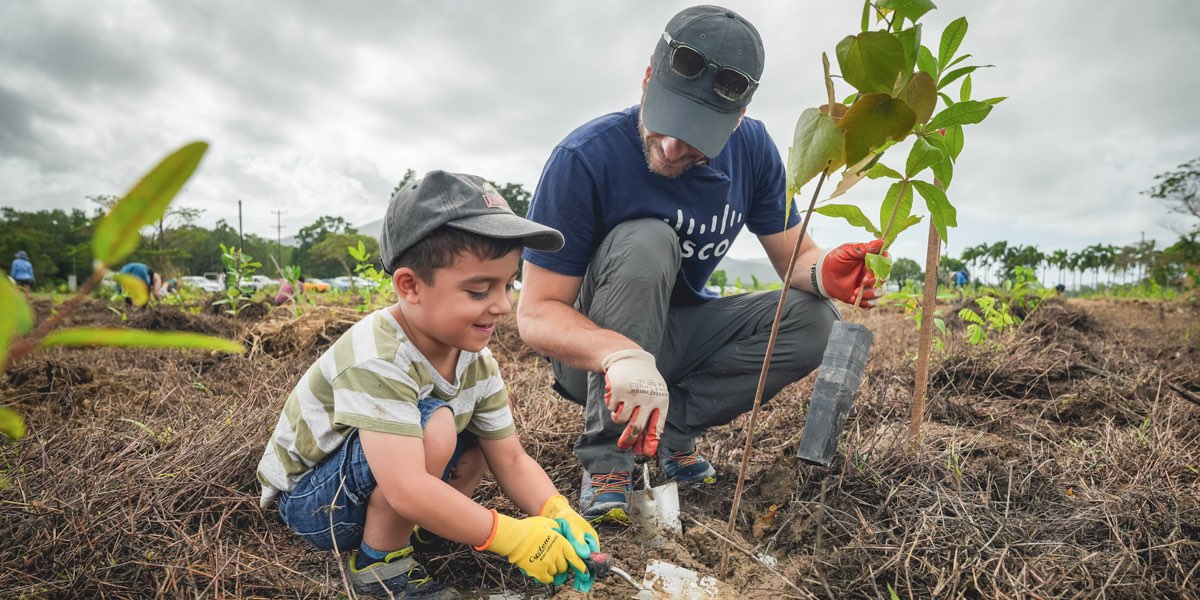
Rainforest Rescuers at the 2026 Annual Community Tree Planting Day © Martin Stringer
THE DAINTREE OXBOW VISION
Now, Rainforest Rescue is embarking on its most ambitious venture yet: The Daintree Oxbow Project.
Located just before the Daintree River ferry crossing, this landscape – shaped by 70 years of sugarcane farming – is on the brink of transformation. Anchored by McDowell Swamp, the lower river’s only natural oxbow lagoon, this unique area is listed on the Directory of Important Wetlands in Australia.
Before it was cleared, this rare meeting point of river, mangroves, wetlands, and rainforest acted like a natural sponge. It slowed floodwaters and filtered runoff long before reaching the Great Barrier Reef.
As intensifying storms carry more sediment toward the reef, this natural filter matters more than ever. Trapped between rising seas and legacy cane levees, the river’s mangrove nursery has nowhere to retreat, restoring the Oxbow gives them room to move inland. Historical 1950s satellite imagery and stories from Eastern Kuku Yalanji elders confirm the rich, specialised forests that once flourished here.
Today, frequent flooding and saltwater intrusion have made farming unsustainable. When the local Mossman sugar mill went under in late 2023 and entered liquidation in early 2024, multi-generational farming families were left facing an uncertain future, opening a rare chance to reimagine the land’s purpose.
For Rainforest Rescue CEO Branden Barber, it’s a path forward for both nature and the community: “This was never nature versus agriculture. When the mill closed, these families needed real options. Restoration gives the land a new job to do while keeping people working the land they know. We’re also helping farmers by taking on stranded assets they’d never sell if they still held economic promise.”
Working alongside the community, Rainforest Rescue has secured more than 120 hectares across three key properties in this once nationally significant wetland. That places approximately one-fifth of the 600-hectare Oxbow landscape under permanent protection, with restoration already underway.
The momentum is already building. On May 16, 2026, Rainforest Rescue hosted its first annual community tree planting day at the Oxbow site, bringing together more than 120 volunteers, staff, and partners who put 5,000 native trees into the ground in a single morning.
“Seeing all those young trees go into the ground was incredible,” Mark says. “The waterlogged earth felt like it was saying, ‘This is what I need.’ You could immediately visualise it transforming from an agricultural monoculture into a rich, living mosaic of wetland forest and pools.”
Across the most recently acquired 91.3 hectares, another 200,000 flood-tolerant trees will follow, reconnecting intact wetland forest straight to the Daintree River and creating a continuous, agriculture-free wildlife corridor for the first time in decades.
“Local river guides will tell you what this stretch once held, and what could return with habitat and time, from the freshwater sawfish to dugongs grazing the river mouth,” Branden says.
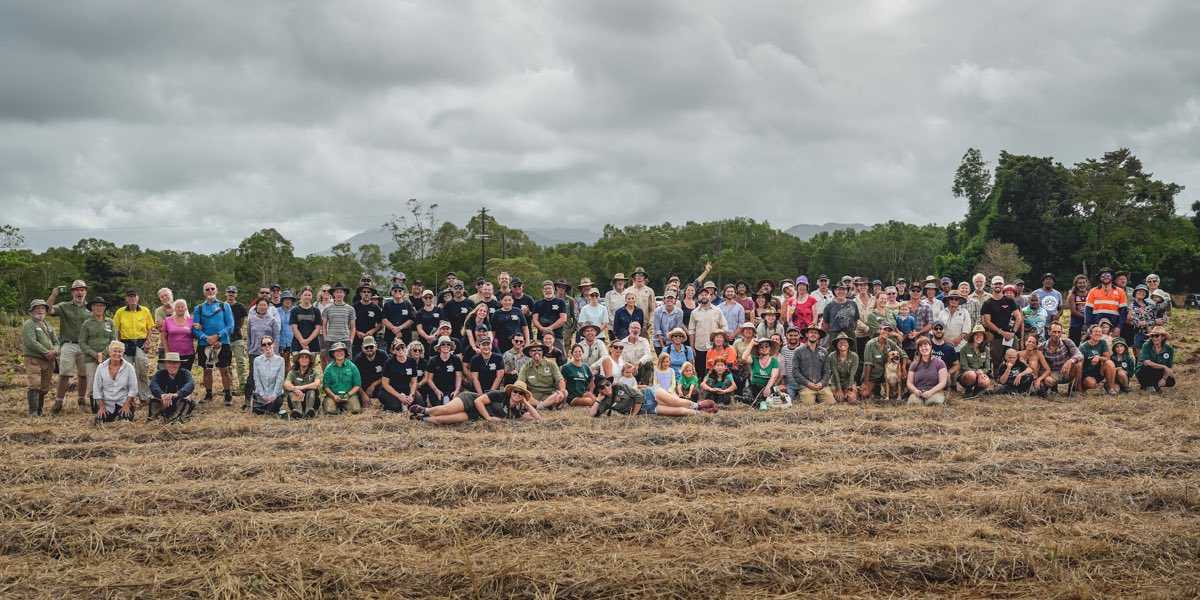
Community coming together for the 2026 Annual Community Tree Planting Day © Martin Stringer
A LEGACY BEYOND RESTORATION
Because the Oxbow sits directly at the Daintree River ferry gateway between two World Heritage icons – the rainforest and the reef – nearly a million people pass the Oxbow each year without realizing its significance.
Looking ahead, low-impact infrastructure like elevated boardwalks, walking trails, and bird hides could transform it into a hub for regenerative tourism, allowing visitors to experience this rare wetland forest while actively leaving the region better than they found it.
“It supports a growing ‘restoration economy,’” Mark notes. “Instead of relying purely on traditional agriculture, locals can build long-term careers restoring the environment. It’s a compelling model for how regional communities can turn environmental renewal into a proud, thriving asset.”
Instead of relying purely on traditional agriculture, locals can build long-term careers restoring the environment. It’s a compelling model for how regional communities can turn environmental renewal into a proud, thriving asset.
For the team behind the project, the momentum is nothing short of extraordinary. “The buzz within Rainforest Rescue is incredible,” Mark says. “When we first began discussing this project, it felt like a very long road ahead of us. Today, roughly one in every five hectares of the Oxbow floodplain is officially under protection. It’s an astounding milestone.”
“You’re standing at the gateway to the oldest rainforest on Earth,” Branden says. “You can help leave it in better shape than you found it. Not many places give you that chance.”
Whether you sign up for project updates, get your hands in the soil on a community planting day, or help secure the next parcel of land, the window to reconnect this landscape is open, make it part of your legacy.

A Legacy That Grows
One of the most encouraging lessons from NightWings is that restoration works. Where sugarcane once grew, young rainforest is now taking hold. Wildlife is returning, and years of patient work have helped secure lasting conservation protection.
The Daintree Oxbow presents a different challenge, on a much larger scale. But the principle is the same: protect what remains, reconnect what has been fragmented, and create the conditions for nature to flourish again.
And importantly, this isn’t a journey we make alone.
Every landholder, volunteer, researcher, partner and supporter contributes something to the future of these landscapes. Together, we’re demonstrating that environmental renewal can also create opportunities for communities and future generations.
As Branden reflects in the article: “You can help leave it in better shape than you found it. Not many places give you that chance.” That’s the opportunity before us, and it’s one worth growing.
Want more good Rainforest news in your life?
Subscribe to our eNews | Follow us on Instagram | Like us on Facebook | Subscribe to our YouTube channel
Help Protect Rainforests Forever
Donate to Protect Rainforests Forever | Become a Rainforest Guardian | Partnership Options