Our Biggest Land Acquisition Yet! 1 in Every 5 Hectares of the Daintree Oxbow Is Now Under Conservation Protection
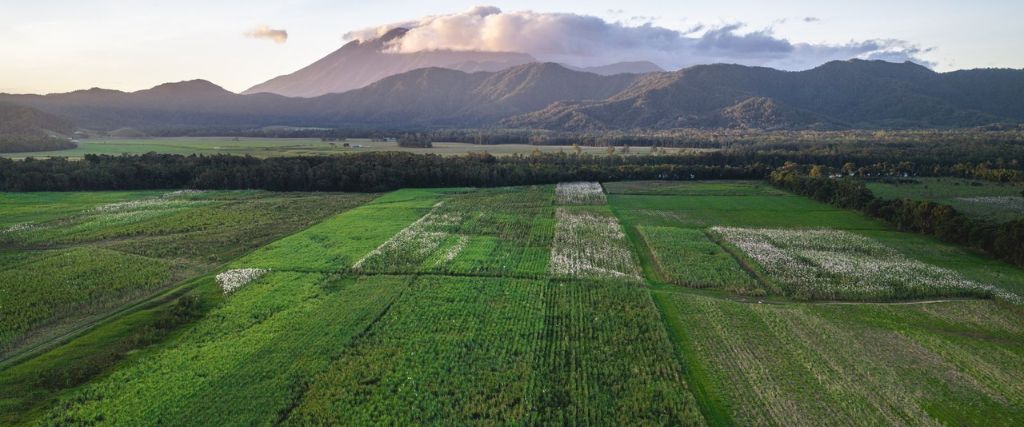
With Thornton Peak/Wundu visible in the background, the two properties that Rainforest Rescue has acquired brings our total Oxbow protected area to 121 hectares. The new acquisitions stretch from the Daintree River to the Oxbow itself. © Martin Stringer/Rainforest Rescue
Rainforest Rescue has just completed its largest land acquisition ever: 91.3 hectares in the Daintree Oxbow, joining the Daintree River to the Oxbow wetland in a contiguous floodplain corridor.
Combined with our existing property at 110 Cape Tribulation Road, we now protect more than 121 hectares in this landscape. One in every five acquirable hectares of the Daintree Oxbow. 3 of the 14 properties that make up our vision for a restored wetland plus rainforest are secure!
It’s a milestone years in the making, and it changes what’s possible for the Oxbow’s recovery.
Why the Oxbow matters
The Daintree Oxbow, anchored by the steadily deteriorating McDowell Swamp, is listed on the Directory of Important Wetlands in Australia, and its vegetation communities are listed under national environment law. It’s a rare mosaic of river, wetland, mangrove and rainforest, and it’s essential habitat for the Southern Cassowary, one of the most iconic and threatened large birds on Earth.
The area is also a potential stopover for migratory shorebirds, with species like Latham’s Snipe and Sharp-tailed Sandpiper travelling through the region, using wetlands like the Oxbow as a refuelling stop on journeys spanning thousands of kilometres.
For decades, much of this landscape has been fragmented by cleared cane paddocks, cutting off the river from the wetland and the wetland from the forest. That’s the fragmentation these new properties begin to repair.
And again, somehow, it’s still listed as it once was: One of Australia’s Important Wetlands.
Fortunately, we have a plan to make that statement true again.
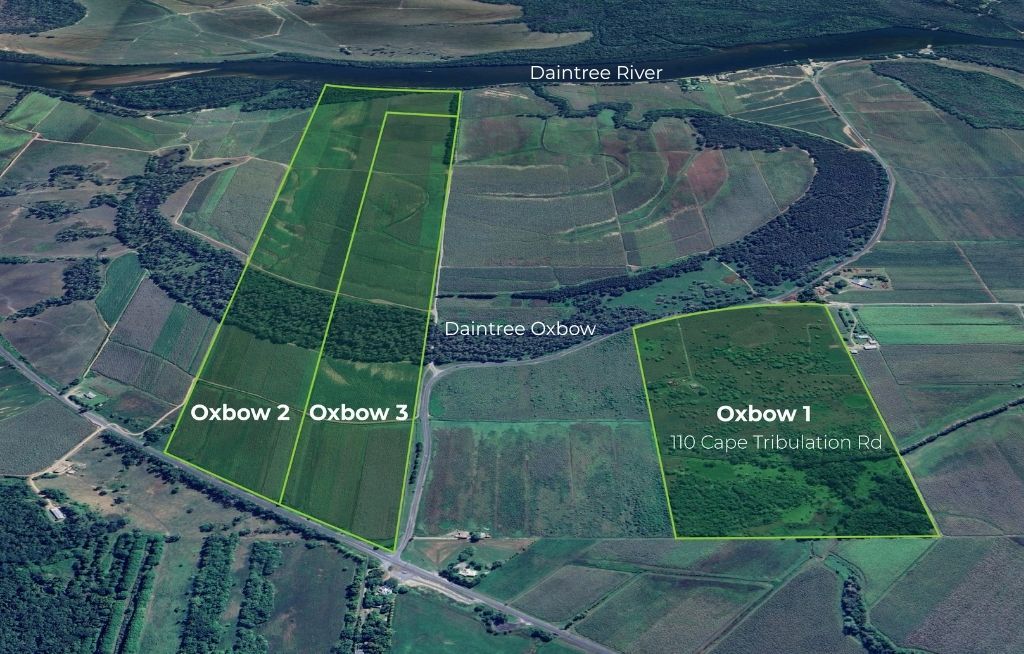
A satellite view shows the footprint of the two new properties, running north/south from river to oxbow to road. © Google Maps/Rainforest Rescue
What’s on the newly protected land
Our Land Manager, Ariel, has walked the new acquisitions and shared what makes them special:
This 10.6ha portion of the Oxbow is the most ecologically intact area of the wetland, with many old remnant trees. Mature trees with high habitat importance include Melaleuca quinquenervia, Syzygium angophoroides, Syzygium hemilamprum, Dillenia alata, Ficus virens, Ficus drupacea, Ficus destruens, Ficus benjamina, Cryptocarya hypospodia, Beilschmiedia obtusifolia, Normanbya normanbyi, Melicope elleryana, and Nauclea orientalis.
“The 78ha of former cane paddocks will be planted with approximately 200,000 trees, with species selected for site conditions, the main constraint being impeded drainage and seasonal inundation.
“This acquisition and planned planting will connect the intact wetland forest to the banks of the Daintree River, massively increasing resources for birds and bats, and begin a new chapter in our mission to rejuvenate the lower Daintree flood plain and Oxbow landscape.”
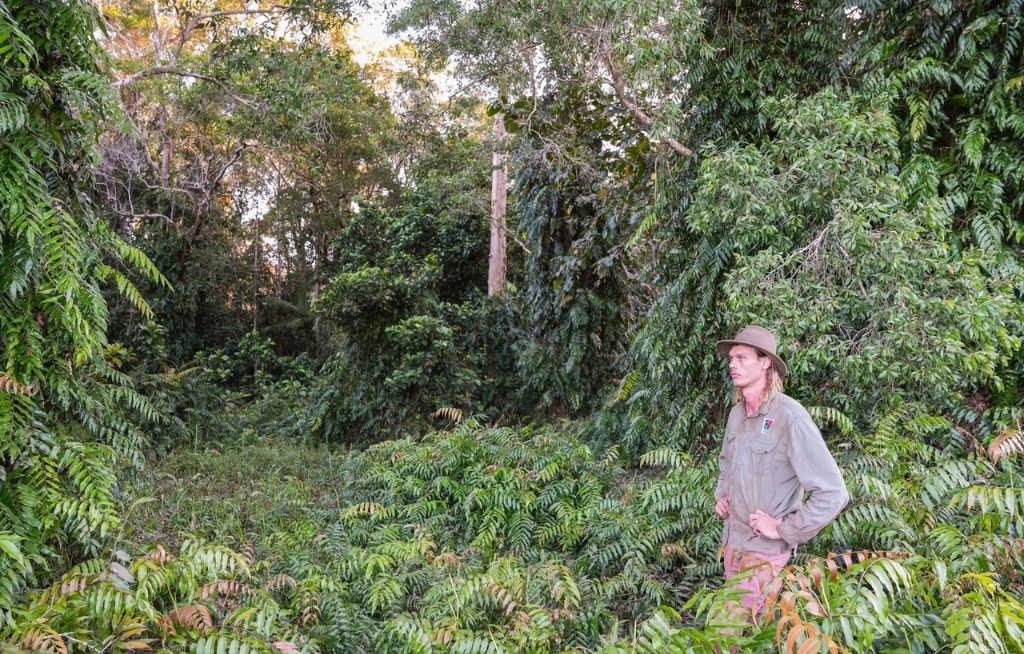
Ariel, our Land Manager, has identified key native flora species amongst the intact areas of habitat. © Martin Stringer/Rainforest Rescue
In short:
- 10.6 hectares of intact wetland forest, largely untouched
- 2.6 hectares of intact mangroves and other vegetation
- 78 hectares of former cane paddock. Cleared, flood-prone, and no longer viable for agriculture, now ready for ecological recovery
That last point matters greatly. Much of this land sits below three metres in elevation and floods regularly, which is exactly why it was marginal for agriculture, and exactly why it will regenerate quickly once replanted. Restoring it will improve water retention across the floodplain, re-establish fish passage through the wetland, and rebuild a nursery ground for aquatic species in the Oxbow and, ultimately, the reef beyond.
Room to grow
For our CEO, Branden Barber, the milestone solves a problem that’s constrained Rainforest Rescue’s restoration ambitions for years.
The challenge with the whole strategy has always been how to balance getting tree production up to max, so we can get restoration activities up to max, when we didn’t own land that could be restored,” Branden says. “It was a real estate problem. Now we’ve solved that problem.”
For the first time, our Daintree Native Nursery has the room to grow and plant at the scale it was always capable of, 150,000 trees a year.
A reminder to us that trees are, and have always been, the answer.
There’s more to come
One in every five hectares of the Daintree Oxbow is now protected. That’s a milestone worth celebrating. It’s a solid foundation, but it’s not the finish line.
But we can picture it.
And with your continued support, we’re able to pursue further Oxbow properties, continuing the work of reconnecting rainforest, wetland, river and reef across this extraordinary landscape.
Thank you for making this possible.
Want more good Rainforest news in your life?
Subscribe to our eNews | Follow us on Instagram | Like us on Facebook | Subscribe to our YouTube channel
Help Protect Rainforests Forever
Donate to Protect Rainforests Forever | Become a Rainforest Guardian | Partnership Options