The world’s oldest rainforest needs restoring. An outdated planning map is in the way.
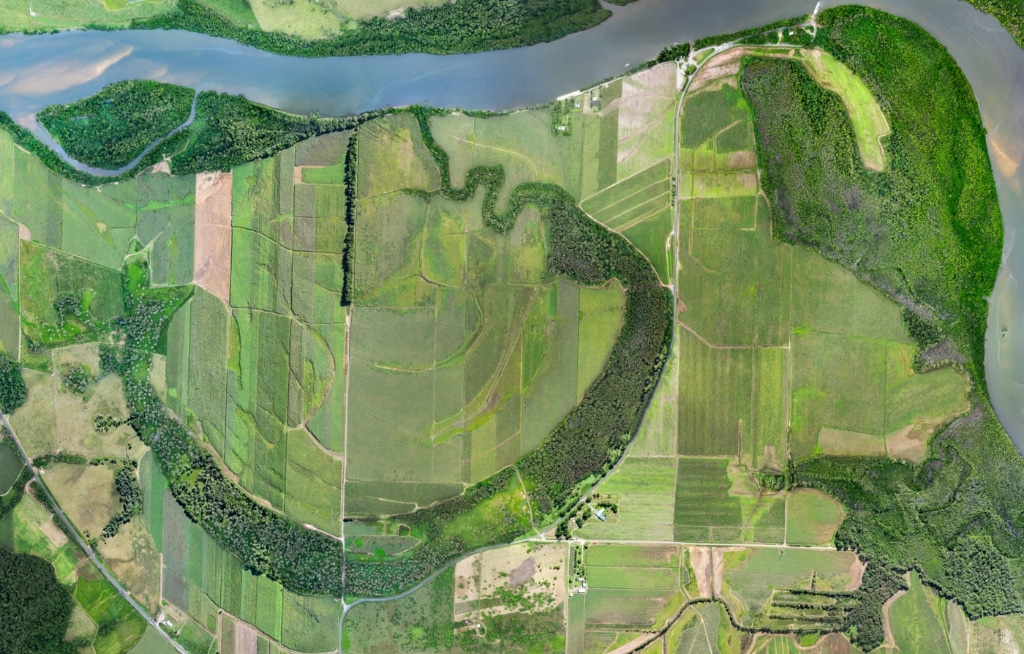
The Daintree Oxbow and surrounding floodplain represents an ecological and economic way forward in the region © Martin Stringer
This Media Release was originally issued by Rainforest Rescue on 1 April 2026 in response to a council decision during the Douglas Shire Council ordinary meeting held on 31 March 2026*. The full council meeting can be viewed online on their YouTube channel. The discussion and decision relevant to the Development Application MCUI 2025_5809 involving Rainforest Rescue begins at 7:50.
A Far North Queensland council has blocked the largest ecological restoration project in the region’s history. Citing the need to protect agricultural land that hasn’t been farmed in up to a decade, on a flood plain that independent experts say is not suitable for agriculture.
On Tuesday, Douglas Shire Council voted to reject most of a proposal by conservation group Rainforest Rescue to restore 430 hectares of abandoned sugarcane land adjacent to the Daintree River — the world’s oldest surviving tropical rainforest. The council approved a small, fragmented portion. Rainforest Rescue says that portion is not viable on its own.
Rainforest Rescue CEO Branden Barber said the organisation was disappointed and surprised by the outcome:
“This is an excellent project by any measure — jobs, economic activity, community support, high environmental value, willing landowners, and land that by any honest assessment isn’t being farmed and can’t be farmed. We’re going to keep working to find a path forward, because this opportunity is too important to walk away from.”
Land that exists as farmland only on a map
The properties at the heart of the dispute — south of the Daintree River on Cape Tribulation Road — have sat largely fallow since the Mossman Central Mill closed permanently in 2024. Some parcels have not been farmed for up to ten years. A fallback transport arrangement to Gordonvale mill south of Cairns collapsed late last year. There are no viable alternative crops. There are no competing buyers for the land.
Independent agricultural specialist Dr Charissa Rixon of T.R.A.P. Services has twice assessed the site and classified it Agricultural Land Classification Code D — not suitable for agriculture — based on flood and storm tide inundation, the absence of a viable mill, and the lack of any economically sustainable alternative crop.
Despite this, the council’s planning scheme designates the area as Good Quality Agricultural Land. This classification was written in 2018, when there was still hope the Mossman sugar industry could be saved.
“Good quality agricultural land must be good quality in reality, not just on a map. Preserving land for a crop that no longer exists is not agricultural protection — it’s policy inertia.”
— Councillor Abigail Noli
Mayor Lisa Scomazzon said the planning scheme required consistent application and that a review currently underway would consider community views on revegetation.
Willing sellers. Waiting landowners.
The five families involved in the proposal are multi-generational farming households with deep roots in the Mossman district. With no viable crop, no income, and rates bills running into the tens of thousands annually, some are now under serious financial pressure and ready to sell.
Rainforest Rescue’s proposal offered them a clear pathway — and a viable economic future for land that currently has none. Branden Barber explained:
“One of them told me today he was desperate. He’s not making any money and he needs to sell. We can help these people. That’s what makes this so frustrating.”
An overwhelming community mandate
Community support for the proposal was extraordinary. Of 41 public submissions received during the statutory notification period, 40 were in support.
Supporters included the Eastern Kuku Yalanji people — the Traditional Owners of the land — who identified the project’s water quality and biodiversity outcomes as aligned with Yalanji principles of traditional land management.
James Cook University, the Wet Tropics Management Authority, and a range of local businesses and residents also submitted support.
 In good company — 40 letters of public support from the local community, including these organisations, endorse the ecological development proposal.
Where two World Heritage Areas meet
The proposed restoration surrounds McDowell Swamp, — the only oxbow lagoon in the lower Daintree and an ecologically significant wetland that has deteriorated steadily since it was drained and cleared for sugarcane farming in the 1950s.
The site sits at the confluence of two UNESCO World Heritage Areas: the Wet Tropics Rainforest and the Great Barrier Reef catchment. Scientific evidence shows that land management decisions in the Daintree River valley directly affect reef health downstream through sediment and nutrient flows.
Independent ecologist Jim Tait of Econcern found four categories of Matters of State Environmental Significance on or directly connected to the site, all were declining under current land use.
Restoration would improve water quality flowing to the Reef, reduce flooding severity, reconnect wildlife corridors for species including the Southern cassowary and Spectacled flying-fox, and generate local employment through revegetation, land management, eco-tourism, and emerging carbon and biodiversity credit markets.
What comes next
Rainforest Rescue will progress restoration within the approved areas and intends to engage actively in the council’s planning scheme review — working alongside the Wet Tropics Management Authority, James Cook University, and other project partners to develop a more nuanced planning framework that reflects the region’s current realities.
The organisation has not ruled out a formal appeal to Queensland’s Planning and Environment Court, but says its preference is to find a workable path forward through the planning reform process. Branden Barber concludes:
“Council has recognised that restoration has a role to play in the future of this landscape. We want to build on that. The question now is whether the planning framework can evolve fast enough to match what’s happening on the ground. It is critical for these farmers, for this ecosystem, and for the generations who will inherit whatever we decide to do here.”
To speak further with Rainforest Rescue on this Media Release and matters related to the Development Application proposal to restore the ecologically significant Daintree Oxbow floodplain, please contact our Communications Manager or CEO for further comment.
*Media Release content updated on 23 April 2026 to reflect the most up to date response to the decision.
Want more good Rainforest news in your life?
Subscribe to our eNews | Follow us on Instagram | Like us on Facebook | Subscribe to our YouTube channel
Help Protect Rainforests Forever
Donate to Protect Rainforests Forever | Become a Rainforest Guardian | Partnership Options