Oxbow Restoration Debate Continues After Council Decision
The recent Douglas Shire Council decision on the Daintree Oxbow proposal continues to resonate across the region.
In this article from Cairns Local News, the outcome—and the broader implications for land use in the Daintree Lowlands—are explored through the lens of a community in transition.
The coverage reflects a growing conversation about how landscapes once shaped by agriculture may evolve in response to changing economic and environmental realities.
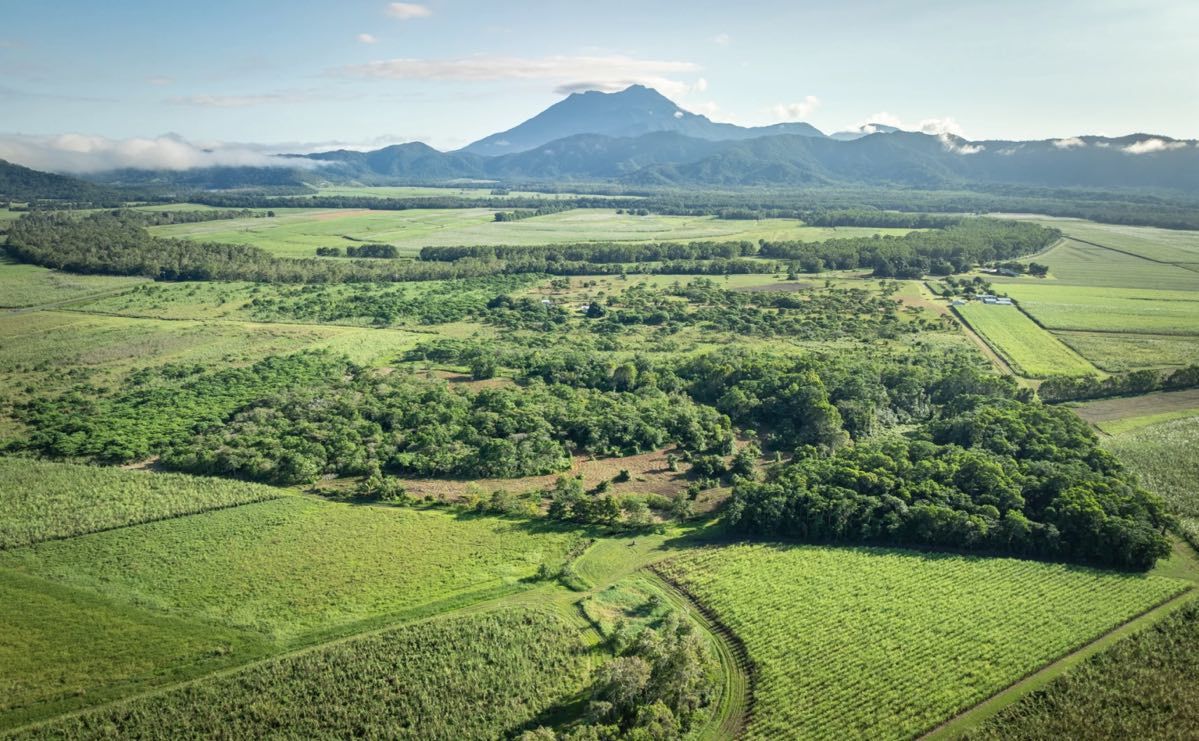
110 Cape Tribulation Road, a key site in the rejected Rainforest Rescue development.
Oxbow is visible in the background, surrounded by the cane farms that are now no longer in use.
© Martin Stringer
A CONSERVATION group is calling for land classifications to catch up to the economic and environmental realities of the Far North, following a watered-down approval by the Douglas Shire Council to grant restricted regeneration of old cane farms.
The ‘Daintree Oxbow Ecological Restoration Project’, proposed by Rainforest Rescue, would have introduced broadscale permanent plantations of native revegetation on a collection of unused former sugar cane farms which sit between the world heritage areas of the Wet Tropics rainforest and the Great Barrier Reef catchment.
The proposal had also garnered local backing with 40 of the 41 public submissions received in support of the proposal, including Traditional Owners – the Eastern Kuku Yalanji people.
At the ordinary meeting on March 31, Cr Abigail Noli was also in support of the full proposal, and moved a motion, seconded by Cr Damian Meadows, which failed.
Instead, councillors agreed to an alternative motion to allow partial regeneration on specified lots, with the majority of land to be kept as a “priority agricultural area”, as classified under its draft Far North Regional plan.
Rainforest Rescue CEO Branden Barber said the outcome, while representing a step forward, highlighted the “tension between historic land classifications and present-day environmental and economic realities”.
“The past is stalling the future,” he said.
“The properties are effectively stranded assets – no longer economically viable for agriculture regardless of soil classification.”
During deliberations, Cr Noli had also argued that “good quality agricultural land must be good quality in reality, not just on a map,” adding that preserving land for industries that no longer operated risked becoming “policy inertia.”
“I’m sure that in your heart, you find it easy to understand the planting of trees adjacent to the world’s oldest rainforest in the historically green shire, on the banks of an immense river that flows into the Great Barrier Reef … is a good thing, but your head hesitates because the council office’s recommendation is only for part allowance,” she said.
“And we all fully understand this recommendation, why it’s there.”
However, she urged councillors to think with their heads.
“That land is not realistically viable for ongoing agriculture. While mapped as good quality agricultural land, (its) historic productivity has always been narrowly dependent just on cane, an industry that no longer exists.”
Mayor Lisa Scomazzon backed the current planning scheme and the protection of agricultural land in the Douglas Shire.
“The partial approval encourages rehabilitation in strategic rehabilitation areas,” she said.
“Any rehabilitation efforts must not take place at the expense of valid agricultural land.
“Most of the land is identified as good quality agricultural land.
“Upholding the planning scheme ensures a consistent, clear standard rather than a piecemeal approach.”
Council ultimately unanimously supported the recommended compromise based on the planning definitions.

The discussion surrounding the Daintree Oxbow reflects a broader shift already underway. As traditional industries change, new approaches to land use—grounded in restoration, resilience, and long-term ecological health—are becoming part of the conversation.
While perspectives may differ, what is clear is that the future of the Daintree Lowlands is being actively shaped in real time.
Rainforest Rescue remains committed to working alongside community, partners, and landholders to support that transition—step by step, for the long term.
Source: Cairns Local News by Andree Stephens posted
Want more good Rainforest news in your life?
Subscribe to our eNews | Follow us on Instagram | Like us on Facebook | Subscribe to our YouTube channel
Help Protect Rainforests Forever
Donate to Protect Rainforests Forever | Become a Rainforest Guardian | Partnership Options