‘Environmental project shelved after council knockback’
The future of the Daintree Lowlands is increasingly part of the regional conversation.
In this NewsPort news article, local reporter Shaun Hollis shares opinion from Rainforest Rescue and Douglas Shire Council councillors following the decision to partly approve the restoration of land surrounding the Daintree Oxbow.
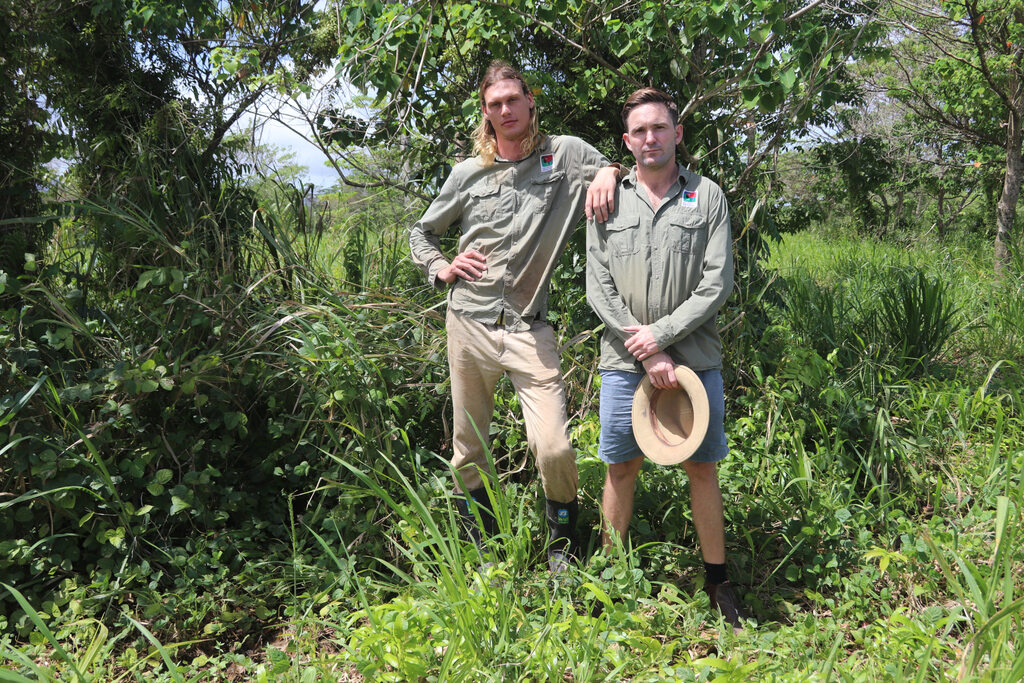
Rainforest Rescue land manager Ariel Simon and general manager Tate Brammer. Picture: Shaun Hollis
Plans to reforest a large tract of inactive farmland on the southern side of the Daintree River have been rejected by Douglas Shire Council, which has voted to keep most of the land available for agriculture in case a viable crop can be found.
In last week’s meeting, the council heard that much of the about 400ha tract of land is unsuitable for cropping, with some of it not being farmed for about 10 years, and since the demise of cane farming in the region, there is no known viable crop which can be farmed there anyway.
The group wanting to reforest, Rainforest Rescue, also currently employs 10 people in the region and wants to employ more workers to help reforest the floodplain, and there is also much support in the region from landowners and Daintree Village locals.
Rainforest Rescue general manager Tate Brammer said the council decision was “disappointing and surprising”.
“This was a terrific project,” Mr Brammer said.
“We’re maintaining jobs, we’re creating jobs, we’re already employing 10 people in the region.
“We’re bringing in external funding and investment, so we’re boosting the local economy.
“It overwhelmingly was supported by the community, so there were 40 letters of support that were provided.
“We are specifically focussing on this one area, because it’s a huge floodplain.”
Councillors Abigail Noli and Michael Rees voted in favour of the project, but the other three councillors voted against it.
“This land is not realistically viable for agriculture, it is narrowly dependent on cane which is no longer viable and it’s on flood-prone, low-lying land,” Cr Noli said.
“This is a legitimate rural transition when sugar cane farmers have no real alternatives that would also benefit the environment, the reef, the river and the shire as a whole.
“Preserving land for a crop that no longer exists is not agricultural protection – it’s policy inertia.”
Cr Damian Meadows said: “We’ve got to maintain our good quality agricultural land”, while Mayor Lisa Scomazzon said the region needed rehabilitation, but not at the expense of “viable agricultural land”.
Cr Rees said he had an “honest disagreement” with the Mayor because this was not “good agricultural land”.
The council eventually voted to allow some partial tree planting, but Mr Brammer said after the meeting this would not make the project viable and the group was exploring its options for appealing in the Planning and Environment Court, or taking their industry elsewhere.

This moment marks an important shift.
As traditional industries in the Daintree Lowlands change, new opportunities are emerging to restore landscapes, reconnect ecosystems, and build long-term environmental resilience.
While decisions like this may not yet reflect the full potential of the landscape, they are part of a broader transition already underway.
Rainforest Rescue remains committed to working with community, landholders, and partners to protect and restore the Daintree—step by step, for the long term.
Source: Newsport – Douglas Shire News (Shaun Hollis, last updated 08 April 2026)
Want more good Rainforest news in your life?
Subscribe to our eNews | Follow us on Instagram | Like us on Facebook | Subscribe to our YouTube channel
Help Protect Rainforests Forever
Donate to Protect Rainforests Forever | Become a Rainforest Guardian | Partnership Options