Cairns Post: ‘Appeal looming as Daintree rainforest revival plan rejected’
The future of the Daintree Lowlands is increasingly part of the regional conversation.
In this Cairns Post headline news article, local reporter Greg McLean shares perspectives from Rainforest Rescue and Douglas Shire Council councillors following the decision to partly approve the restoration of land surrounding the Daintree Oxbow.
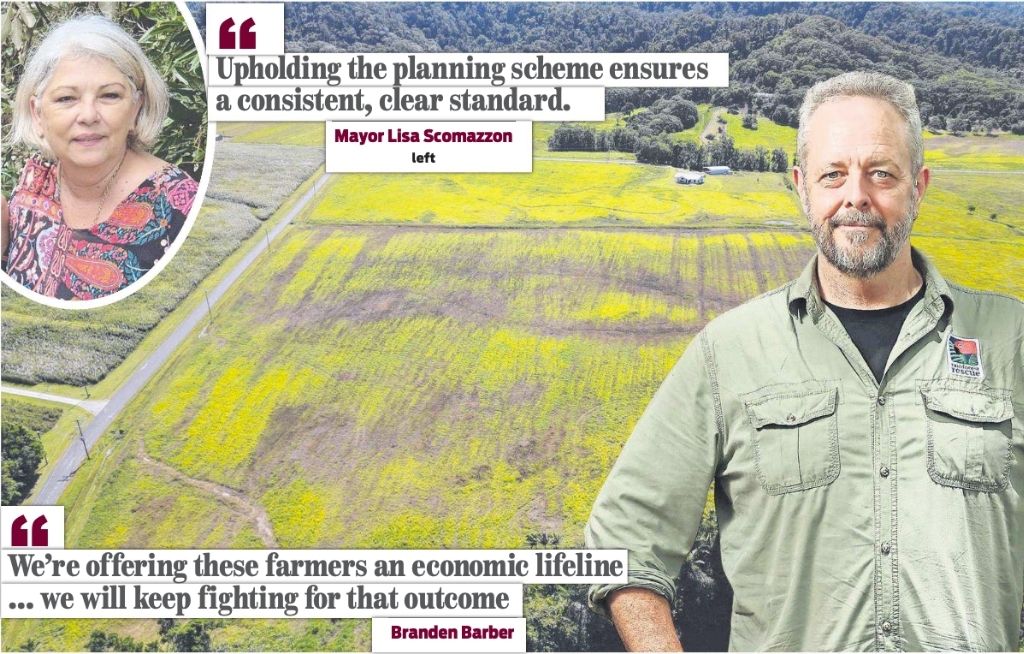
Composite picture: Rainforest Rescue/Cairns Post
Court action pending after council blocks Daintree eco-project
Douglas Shire Council has been accused of squandering an environmental opportunity by rejecting a plan to transform disused cane fields into a Daintree wetland. With the collapse of the Mossman sugar industry critics have questioned clinging to outdated zoning maps at the expense of an ‘economic lifeline’.
Daintree rainforest revival plan rejected
Douglas Shire Council has rejected a proposal to convert agricultural land on the southern fringe of the Daintree River which is not currently suitable for any farming purpose into a revegetated wetland plantation.
Rainforest Rescue submitted a development application to convert 430ha of land adjacent to the Daintree River, which is owned by five multi-generational farmers and was previously used for sugar cane cultivation, into a revegetated permanent plantation of native rainforest species eligible for carbon and biodiversity credits.
Due to the area’s susceptibility to flooding, poor soil quality and the total collapse of the sugar cane industry in the Mossman district, it is no longer financially viable for crops to be planted there.
Council’s decision on Tuesday to support the planner’s recommendation to reject all but a small fragmented portion of the development application was largely based on the fact the land is designated as agricultural in the Douglas Shire Planning Scheme.
Councillor Abigail Noli introduced a motion to fully support the development application, which was endorsed by Cr Michael Rees. However, Mayor Lisa Scomazzon, Deputy Mayor Roy Zammataro and councillor Damian Meadows voted against the motion, before all five councillors voted in support of the partial approval.
“Good quality agricultural land must be in reality, not just on a map,” Ms Noli said at the meeting.
“This land is not realistically viable for agriculture, it is narrowly dependent on cane which is no longer viable and it’s on flood-prone, low-lying land.
“Rejecting this proposal does not achieve meaningful, viable economic outcomes.
“This is a legitimate rural transition when sugar cane farmers have no real alternatives that would also benefit the environment, the reef, the river and the shire as a whole.”
Ms Scomazzon reiterated her support for the current planning scheme and the protection of agricultural land in the Douglas Shire.
“The partial approval encourages rehabilitation in strategic rehabilitation areas,” Ms Scomazzon said.
“Any rehabilitation efforts must not take place at the expense of valid agricultural land.
“Most of the land is identified as good quality agricultural land.
“Upholding the planning scheme ensures a consistent, clear standard rather than a piecemeal approach.”
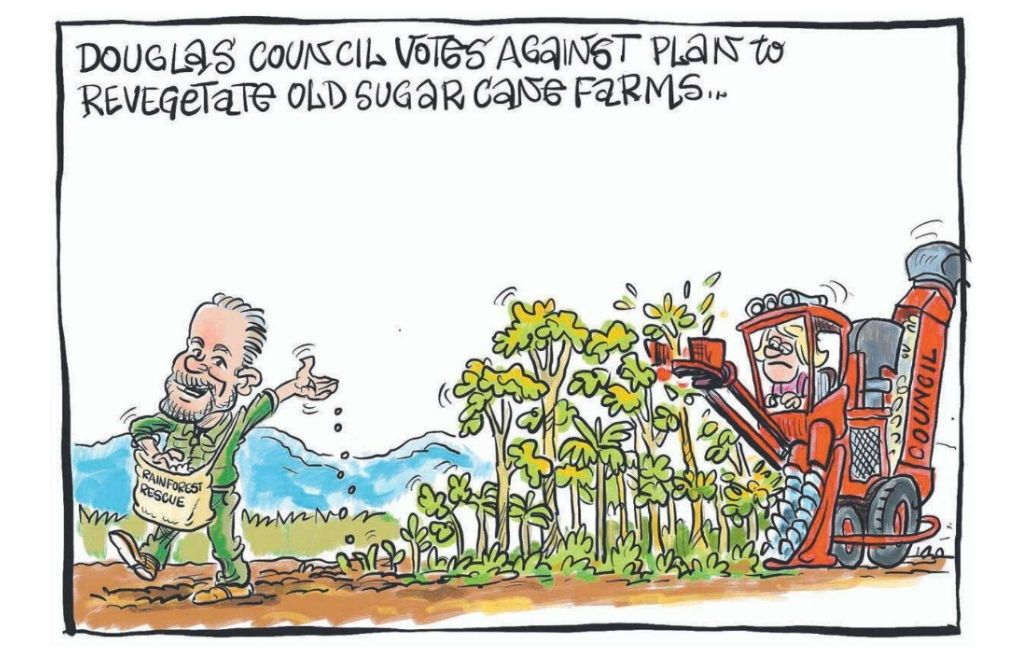 Cartoon: Cairns Post
While welcoming council’s partial approval, Rainforest Rescue CEO Branden Barber said it was not viable to go ahead with the small fragmented parcel approved and confirmed his organisation was likely to appeal to the Queensland’s Planning and Environment Court.
“Unfortunately Douglas Shire Council’s planning scheme hasn’t caught up with what’s happening on the ground,” he said.
“The only thing you could grow viably in this location is sugar cane due to it being so flood-prone and poor soil quality, and that is no longer an option for these farmers due to the collapse of the industry. We’re offering these farmers an economic lifeline and offering jobs to revegetate an ecologically important part of the Daintree Rainforest and we will keep fighting for that outcome.”
DECISION AT A GLANCE
Proposal: 430ha revegetated with a permanent plantation of native rainforest species, seeking carbon and biodiversity credits
Outcome: Partial approval of small, fragmented areas; broader conversion rejected
Reason cited: Land designated agricultural under the planning scheme; protection of “good quality agricultural land”

This moment marks an important shift.
As traditional industries in the Daintree Lowlands change, new opportunities are emerging to restore landscapes, reconnect ecosystems, and build long-term environmental resilience.
While decisions like this may not yet reflect the full potential of the landscape, they are part of a broader transition already underway.
Rainforest Rescue remains committed to working with community, landholders, and partners to protect and restore the Daintree—step by step, for the long term.
Source: Cairns Post (Greg McLean, 01 April 2026) Note: A paid subscription is required to view this article online.
Want more good Rainforest news in your life?
Subscribe to our eNews | Follow us on Instagram | Like us on Facebook | Subscribe to our YouTube channel
Help Protect Rainforests Forever
Donate to Protect Rainforests Forever | Become a Rainforest Guardian | Partnership Options