Critter Corner – Wompoo Fruit-Dove
#CritterCorner – Sometimes the rainforest gives itself away before you see it. A deep, resonant call drifts through the canopy. “Wompoo… wompoo…” You stop and look up, but the bird remains hidden among the leaves.
The Wompoo Fruit-Dove (Ptilinopus magnificus) is one of Australia’s most beautiful rainforest birds, yet it often goes unnoticed high above the forest floor. In fact, many people hear a Wompoo long before they ever see one.
This species holds a special place in Rainforest Rescue’s heart. The Wompoo Fruit-Dove was a favourite of our co-founder, Dr Tony Parkes AO, whose love for the rainforest continues to inspire our work today, and it’s easy to understand why.
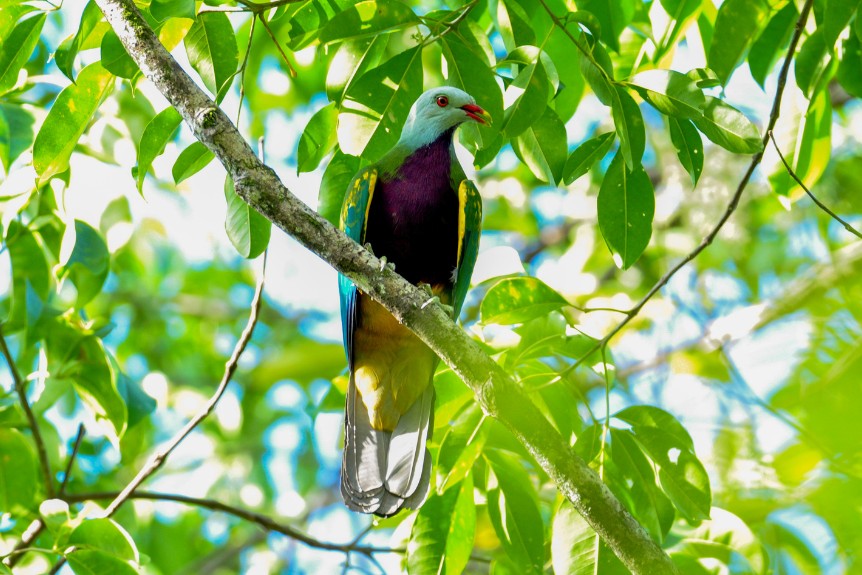
The Wompoo is Australia’s largest fruit-dove, growing between 35 and 45 centimetres in length. Rich purple feathers adorn its throat, chest and upper belly, contrasting with a bright yellow lower belly, green wings and a pale grey head. A splash of yellow on the wing and an orange-red bill complete the picture. Yet, despite its colourful plumage, the Wompoo can be surprisingly difficult to spot. It spends much of its time moving quietly through the canopy in search of fruiting trees.
Found along parts of Australia’s east coast, from New South Wales to Cape York, as well as New Guinea, the Wompoo is rarely seen far from rainforest. Rather than travelling vast distances, it moves through local areas following seasonal food sources.
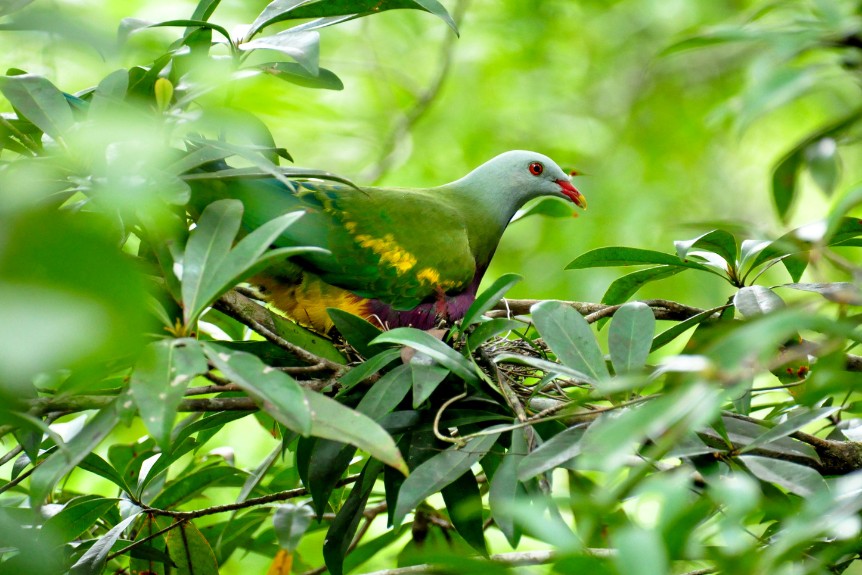
Fruit is at the centre of their lives. Wompoos feed on a wide variety of rainforest fruits, swallowing them whole, even when they seem remarkably large for the bird’s size. When trees are heavily laden, several birds may gather together to feed among the branches, acrobatically plucking fruit from vines and foliage high above the ground.
The seeds of many rainforest plants pass unharmed through the bird’s digestive system before being deposited elsewhere. This helps disperse seeds across the landscape and gives new plants the opportunity to grow. Like cassowaries, musky rat-kangaroos and flying-foxes, Wompoos are among the rainforest’s gardeners.
Breeding season generally occurs between August and January in Australia. Both parents work together to build a simple twig nest, incubate the egg and care for their chick. The male typically takes the daytime shift on the nest, while the female incubates overnight.
Although the species is more common in the northern parts of its range, clearing of rainforest habitat has contributed to declines in southern populations. The Wompoo Fruit-Dove is listed as Vulnerable in New South Wales, where it has disappeared from some areas it once inhabited.
Protecting rainforest habitat means protecting the fruiting trees these birds rely upon for food and shelter. In return, Wompoos help regenerate the forest by carrying seeds beyond the parent tree. It’s one of the countless partnerships that help keep rainforest ecosystems healthy and diverse.
The next time you hear a deep “wompoo” echoing through the canopy, take a moment to listen. You may not see the bird straight away, but you’ll know one of the rainforest’s great seed dispersers is nearby.
Fun Facts About Wompoo Fruit-Doves
- Australia’s Largest Fruit-Dove: The Wompoo is the largest fruit-dove species found in Australia.
- Named After Its Call: Its distinctive “wompoo” call gave the bird its wonderfully memorable name.
- Canopy Acrobat: Wompoos can pluck fruit from trees and vines while balancing high in the rainforest canopy.
- Shared Parenting: Both parents help build the nest, incubate the egg and raise the chick.
- Hard to Spot, Easy to Hear: Most people hear a Wompoo long before they catch sight of one.
References
- Photos courtesy of Allen Sheather (Wild Wings and Swampy Things)
- Australian Museum
- Big Scrub Rainforest Conservancy
Want more good Rainforest news in your life?
Subscribe to our eNews | Follow us on Instagram | Like us on Facebook | Subscribe to our YouTube channel
Help Protect Rainforests Forever
Donate to Protect Rainforests Forever | Become a Rainforest Guardian | Partnership Options