“A new chapter begins!” Our first Daintree Oxbow Annual Community Tree Planting
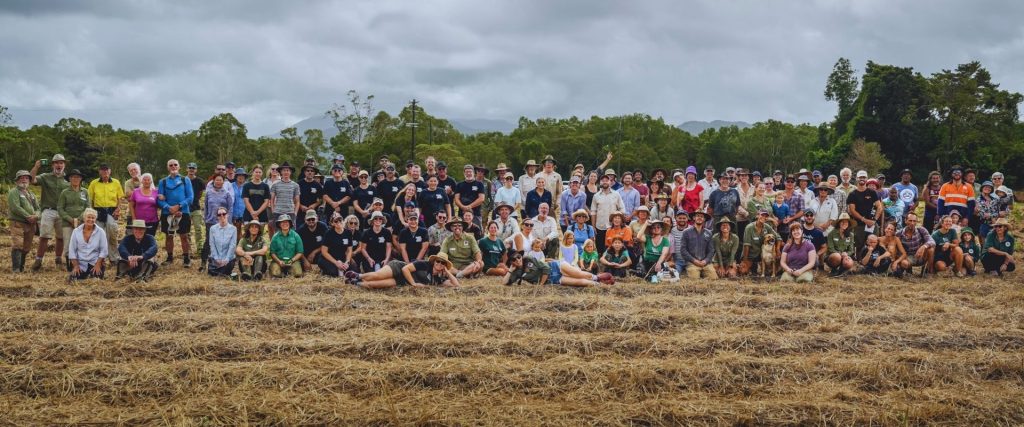
Beginning this new chapter together — 126 tree planters at 110 Cape Tribulation Road.
“This is a very, very historic moment for Rainforest Rescue and for this area. This is a really beautiful gift that we’re all bringing here today — to put nature back. And that’s a beautiful thing, and we should all be really grateful and really proud that we’re able to be a part of this.’
— Branden, CEO, Rainforest Rescue
Saturday 16 May 2026 was a day that will stay with everyone who was there.
In the week leading up to the planting, thousands of young trees stood in rows in the nursery hardening area — their roots ready, their moment coming. A week of tropical rain had brought them to peak condition. It had also left the ground at 110 Cape Tribulation Road heavy with water, the prepared furrows reflecting cloud and sunlight in still pools across the floodplain. Standing at the edge of the planting area, you could almost feel the land reaching toward what it was about to become.
A loose flock of cuckoo-shrikes passed overhead in their easy, bouncing flight. It was easy to imagine jacanas and egrets will be picking their way along the waterlogged edges as somewhere beneath the surface amphibians and invertebrates escape from sharp beaks. A promise of life yet to flourish, but it will.
This was the first Rainforest Rescue Annual Community Tree Planting at 110 Cape Tribulation Road. After a decade of consecutive plantings at NightWings Rainforest Centre, a new chapter had begun. What a way to open it!
Together, 126 people — volunteers, local residents, conservation partners, ecologists from across the Wet Tropics, and friends who had travelled from further afield — made it happen.
126 people in attendance
5,000 trees in the ground
15,900 m² (1.59 hectares) planted
As a statement of intent for this new era of restoration, the Nursery and Land Management team had set their sights on planting more trees, across more area, in a single session than ever before. The result speaks for itself.
This happens because the functionality/content marked as “Google Youtube” uses cookies that you choosed to keep disabled. In order to view this content or use this functionality, please enable cookies: click here to open your cookie preferences.
Restoring the Daintree Oxbow begins here
As Branden explained to the crowd gathered that morning: with the sugarcane industry having departed Mossman, this land has become what he called a ‘stranded asset’ — former farmland whose highest future value lies not in agriculture, but in restoration.
This is particularly relevant here, at the Oxbow. We’ve had two independent ‘Good Quality Agricultural Land’ assessments done — both showed that the original decision to drain and clear the once thriving wetland was a mistake — this land is not good quality agricultural land. And with the demise of the sugar cane industry, this land has a second chance to be what it was meant to be — a thriving ecological engine of life: a rich and wild wetland, connected to the Daintree River, flowing through the world’s most biodiverse mangrove system once again.
The goal is to raise enough to purchase all the properties across the Oxbow, restore the wetland to its original state, and reconnect it to the Daintree River. So that, as Branden put it, dugong, sawfish, and barramundi can once again move through these waters, free of the chemical runoff that has been poisoning the mangroves and the reef.
Less than 18 months ago, thanks to the extraordinary generosity of Rainforest Rescue supporters, we acquired 110 Cape Tribulation Road. The intention was clear from the beginning: to begin a new era of native habitat protection and restoration on the Daintree lowlands surrounding the Oxbow.
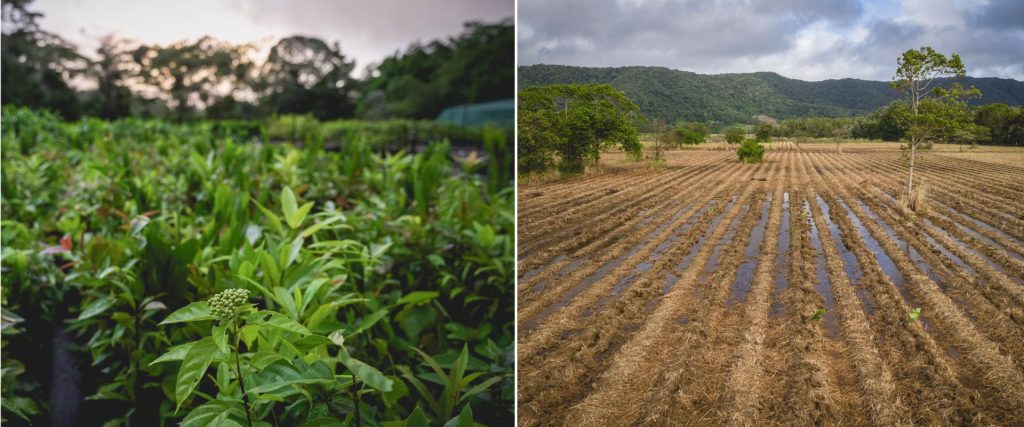
Trees ready to go into the ground at 110 Cape Tribulation Road. © Martin Stringer
May is a time of change in Far North Queensland, as the wet and dry seasons switch places and growing conditions improve for native habitat restoration. On site, the waterlogged ground was a reminder of what this land really wants to be again: floodplain forest. The signals are already there, in the pooled water and the soil itself, the appearances of hawking dragonflies, and sightings of wading birds during the wet season. In many ways, all we had to do was help it along.
Prior to purchase, this site was a derelict farm. Abandoned many years ago, the property had become too challenging to manage. Sugarcane yields were dwindling, and much of the land had become inaccessible during the wet season. Nature was reclaiming this place wherever it could. A pocket of dense regrowth surrounding a modified creekline gave clues to what threatened habitat types would have occurred here over a century ago.
This planting also coincided with wonderful restoration news from nearby: NightWings Rainforest Centre (where Rainforest Rescue had planted trees for ten consecutive years) was officially declared an area of high nature conservation value under the Vegetation Management Act 1999.
It means the young rainforest growing on this land is now formally recognised by the Queensland Government and protected from clearing. The restored vegetation at Nightwings now receives a similar level of protection to remnant vegetation in an endangered regional ecosystem. For land that was bare sugar cane country just a decade ago, that is remarkable. Annie, NightWings owner, then shared wonderful news of returning Spectacled Flying-foxes and recent Cassowary sightings amongst the restored rainforest there.
Two places of renewal for Nature, one day. The momentum felt undeniable.
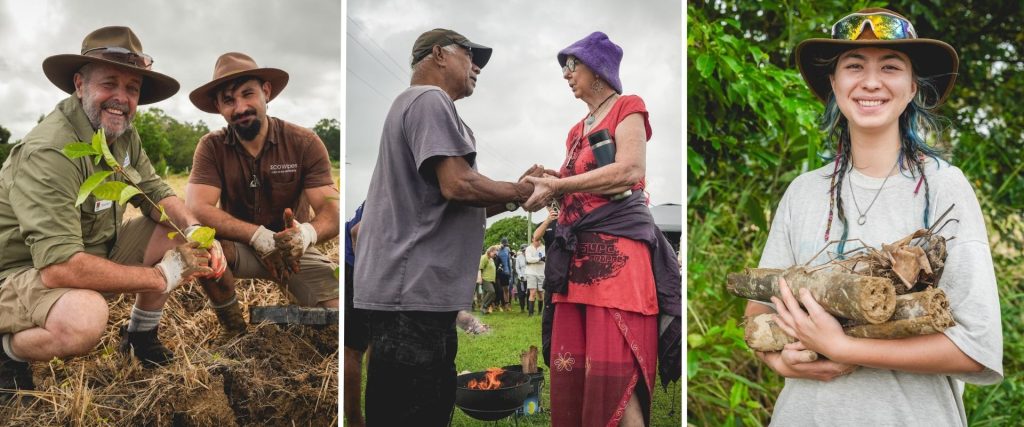
A few of the incredible people who came along to get their hands dirty for the Daintree Oxbow. © Martin Stringer
Respectful stewards of this country
Bennett Walker, Yalanji Elder and a Traditional Custodian of this land, warmly welcomed everyone to Country. He spoke with quiet pride about what was taking place.
“This is my father’s country. I grew up as a kid running around in this bit of forest here… I think my dad will be happy to see this planting happen.”
— Bennett Walker, Yalanji Elder
Bennett recalled travelling this country as a young child riding with his father on the truck that carried meat along the dirt track between Daintree Township and Mossman. The forest he ran through as a boy was the same land that had since been cleared and that we were now, together, beginning to restore.
He spoke of his grandchildren, some of them present on the day, and of how good it was to see this work continuing. He had been involved in tree planting with Annie Schoenberger at NightWings since 2015, and he was glad to see the momentum carry to new ground.
In many ways, while we plant for the future, we are also planting for the past — acknowledging that some of what we restore had never been lost in the hearts of those who called it home.
Bennett also performed the smoking ceremony at the close of the opening proceedings, sending everyone safely onto Country for the day’s work.
Pioneering plants, carefully chosen
It’s amazing to realise that the preparation for this planting began many months in advance, and in some cases, years.
Some of the trees that went into the ground on 16 May were first collected as seeds from the forest over two years ago. The oldest seeds, from Alexandra Palms, had been propagating since April 2024.
In total, the planting drew on 48 rainforest species, selected specifically for this site from a curated list of 110 species suited to the floodplain ecosystem. The most numerous were Acacia mangium and Glochidion sumatranum, with a handful of rarer additions rounding out the diversity.
In the week before the planting, thousands of young trees were lined up in the nursery hardening area, the recent rainfall bringing them to peak condition. Late on Friday afternoon, they made the journey to the site — ready for the morning.
The choice of species for this floodplain site was deliberate and ecologically informed. Three species exemplify the approach:
- Acacia mangium — A characteristic pioneer of this ecosystem, Acacia mangium works in partnership with soil bacteria to restore nitrogen cycling, rebuilding the fertility that the land needs to support what follows.
- Melicope elleryana (Pink Euodia) — Fast-growing and swamp-loving, this species helps define the regional ecosystem. Its flowers are a vital nectar source for wildlife, and its foliage is a host plant for the larvae of the Ulysses Butterfly.
- Syzygium hemilamprum — A characteristic canopy tree of swampy floodplain country, its flowers provide nectar and its berries feed the birds and animals that will one day call this place home.
Planted together in the right proportions and the right places, these 48 species will grow, seed, and develop into the layered, self-sustaining rainforest that this floodplain has been waiting to become again.
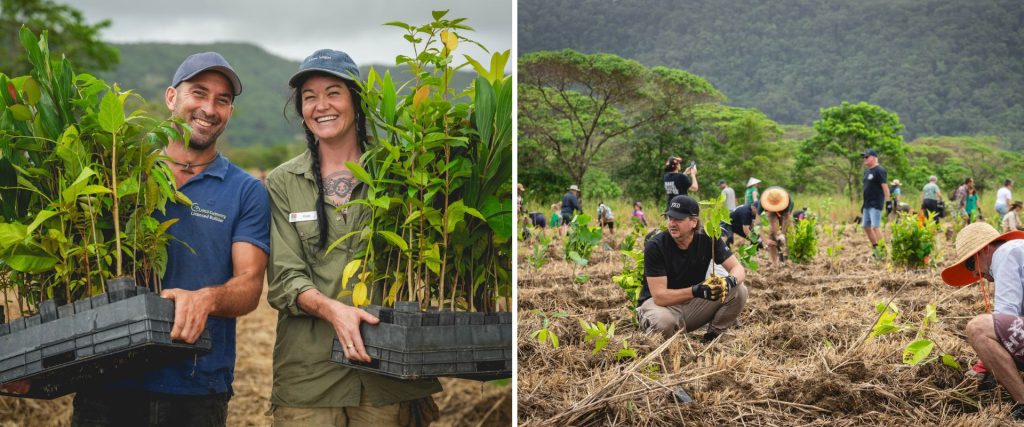
All smiles as thousands of trees are planted in the Daintree floodplain soil. © Martin Stringer & Matilda Brown
It takes a community to plant a rainforest!
“Today feels like a festival. A tree planting festival. The community here has been so welcoming and full of joy.”
After so much preparation, hearing this from a fellow planter filled us with immense pride.
The community who showed up on 16 May reflected the breadth of care that exists for this landscape. Regional ecologists worked alongside interstate volunteers who had shaped their entire trip to the Tropics around the planting. Long-time local residents brought friends and family. People who had made Far North Queensland their home after arriving from overseas stood alongside conservation experts who had spent careers in these forests. This area means a great deal to a great many people.
Among those present were members of the Wet Tropics Restoration Alliance, including Jabalbina Yalanji Aboriginal Corporation, Biodiversity Legacy, Wet Tropics Management Authority, Terrain NRM, Climate Force and C4 (Community for Coastal and Cassowary Conservation).
Rainforest Rescue’s incredible business partners happily squelched through the puddles and mud to get trees into the ground — special mentions go to:
- Our inaugural Obsidian Partner, The Travel Corporation and their local presence of Down Under Tours who came with the biggest business contingent yet to a Planting Day!
- Ambius Australia, proud Silver Partner and 6th year of planting
- B Alternative and Eco Wipes, who travelled the furthest to join us and are now into their 7th year of planting — their team helped our youngest volunteers to build ‘insect hotels’ from found items, encouraging native bees and beetles to find a place to make a home
- CISCO Foundation, marking the beginning of a partnership centred on restoration and conservation data insights;
- and of course, local legends Daintree Discovery Centre, one of our longest supporting Business Partners who kindly provided visitor passes to all who attended on the day.
To all of you: thank you for bringing so much energy to this special planting.
Trees are the answer
“In today’s global outlook, planting a tree is an act of defiance,” remarked our Communications Manager before handing to Branden. “We’re not taking away, we’re putting back, and we’re giving.” But Branden wanted to go further.
“Is it defiance? I think it’s more positive than that. I think it’s a really beautiful gift that we’re all bringing here today. To put nature back.”
— Branden, CEO, Rainforest Rescue
Not extractive. Contributive. Nature Positive.
Branden spoke about the broader vision of leveraging new environmental markets to demonstrate that you can make a living by working with nature rather than against it. The Oxbow is at the leading edge of that possibility.
“This is a very exciting time to work in this area, because this region is very much in transition… Thanks to every one of you for coming out today to be part of this valiant effort and this beautiful new beginning for the Oxbow.”
— Branden
Now it’s time to grow
The final tree of 16 May 2026 went into the ground and settled into the heavy, waterlogged soil of the Daintree floodplain. Above it, a Helmeted friarbird arced across the sky. In the future, its offspring will alight in these canopies.
The plan now is to return every year to the Oxbow, for the next 15 to 20 years. With the Cow Bay nursery approaching full capacity of 150,000 trees per year, and more people working on this land than ever before, the pace of restoration is only going to grow.
For those of us who drove past NightWings on the way in and saw the canopy that ten years of community planting has built, we already know what patience and persistence can do. We’re doing that here now.
We are so grateful to everyone who made this day possible. Our supporters, our partners, our volunteers, and our community. You make us possible. You make us successful. We are so much better together.
#TreesAreTheAnswer
Want more good Rainforest news in your life?
Subscribe to our eNews | Follow us on Instagram | Like us on Facebook | Subscribe to our YouTube channel
Help Protect Rainforests Forever
Donate to Protect Rainforests Forever | Become a Rainforest Guardian for as little as $2 a month | Partnership Options