
Critter Corner – Tree Kangaroos
#CritterCorner – Would you believe us if we told you there are kangaroos that climb trees in the Daintree Rainforest?
Introducing Lumholtz’s Tree Kangaroo (Dendrolagus lumholtzi) and Bennett’s Tree Kangaroo (Dendrolagus bennettianus), the only two tree kangaroo species found in Australia.
Tree kangaroos are unique macropods found only in the rainforests of Far North Queensland and Papua New Guinea. Australia is home to two endemic species, meaning they occur nowhere else in the world. Papua New Guinea is home to another 12 species.
Tree kangaroos evolved from tree-dwelling ancestors. Unlike possums, they are true kangaroos. During their evolutionary history, kangaroo ancestors moved onto the ground as Australia became drier, while tree kangaroos returned to life in the rainforest canopy.
This three-dimensional lifestyle has shaped their bodies in remarkable ways. Tree kangaroos have strong forelimbs with long claws, shorter hind legs, broad padded feet for gripping branches, and are the only macropods able to move their hind legs independently. This allows them to walk forwards and backwards along branches and manoeuvre through dense rainforest vegetation.
They can also rotate their ankles inward, helping them climb up and down tree trunks. Despite their size, they are incredibly agile and can leap from heights of up to 10 metres without injury.
Tree kangaroos use their long tails for balance when moving through the canopy or reaching for food. Although the tail cannot grip branches, it acts as a counterweight and helps them navigate life high above the forest floor. When resting, they often curl up with their tail tucked beneath them.
They are highly intelligent animals and have the largest brain-to-body-mass ratio of any marsupial, likely an adaptation to navigating the complex rainforest canopy.
Tree kangaroos are often difficult to spot. Their colouring provides excellent camouflage and they typically spend their time high in the trees.
They are generally solitary animals, although mothers may be accompanied by dependent joeys, and adult males may occasionally visit. Joeys can remain with their mothers until around two and a half years of age.
Bennett’s Tree Kangaroo (Dendrolagus bennettianus)
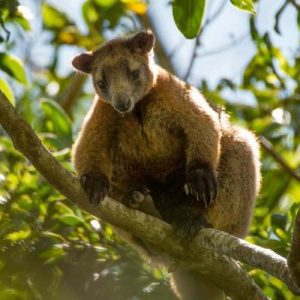 The Bennett’s Tree Kangaroo (Dendrolagus bennettianus) is the larger of Australia’s two tree kangaroo species.
Adults typically weigh between 11 and 14 kilograms. Their body length ranges from 690–760 mm, while their tail can measure 740–840 mm.
They are found in the Wet Tropics rainforests north of the Daintree River and are classified as Near Threatened (NT) on the IUCN Red List.
Bennett’s Tree Kangaroos are folivores, feeding mainly on leaves, fruit and flowers from more than 33 rainforest plant species. This dependence on rainforest vegetation highlights the importance of protecting habitat in the Daintree and beyond.
Bennett’s Tree Kangaroos are believed to be more active during the morning and afternoon, possibly due to the higher temperatures experienced in the Daintree rainforest.
Threats include habitat loss and fragmentation, which expose tree kangaroos to predators and increase the risk of vehicle strikes.
Lumholtz Tree Kangaroo (Dendrolagus lumholtzi)
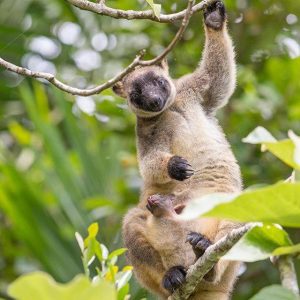 The Lumholtz’s Tree Kangaroo (Dendrolagus lumholtzi) is the smaller of Australia’s two tree kangaroo species.
Average weight ranges between 6.3 and 7.6 kilograms, although males can reach 12.5 kilograms and females 10.5 kilograms. Head and body length ranges from 450–700 mm, with tails measuring between 500–800 mm.
They occur south of the Daintree River to the Cardwell Range and are most commonly associated with the Atherton Tablelands. They are also classified as Near Threatened (NT) on the IUCN Red List.
Boongary, Muppie and Mabi are local Indigenous names for the species on the Atherton Tablelands.
Lumholtz’s Tree Kangaroos are primarily folivores, feeding on leaves from more than 140 rainforest plant species, as well as some fruits and flowers.
Unlike popular belief, Lumholtz’s Tree Kangaroos are not nocturnal. They are active both during the day and at night (cathemeral) and may cross roads or paddocks when searching for new territories after being displaced by more dominant individuals.
Threats include habitat loss and fragmentation, vehicle strikes, and predation by domestic and wild dogs. Over the past century, much of their habitat has been cleared for timber and agriculture, leaving smaller and more isolated areas of rainforest.
It is important that pet dogs are kept securely contained or on a lead, particularly in areas close to rainforest habitat on the southern Atherton Tablelands.
Fun Facts About Tree Kangaroos
- Australia Has Two Species: Lumholtz’s Tree Kangaroo and Bennett’s Tree Kangaroo are the only tree kangaroo species found in Australia.
- Built for Life in the Trees: Tree kangaroos can move their hind legs independently and rotate their ankles inward, helping them climb up and down tree trunks.
- Remarkable Jumpers: They can leap from heights of up to 10 metres without injury.
- Tail for Balance: Despite their long tails, tree kangaroos cannot grip branches with them. Instead, they use their tails as a counterbalance while climbing and reaching for food.
- Different Neighbours: Bennett’s Tree Kangaroos are found north of the Daintree River, while Lumholtz’s Tree Kangaroos are found south of the Daintree River, primarily on the Atherton Tablelands.
- Day and Night: Unlike what many people believe, Lumholtz’s Tree Kangaroos are not nocturnal, they are active during both the day and night.
References
- Dr Karen Coombes at Tree Roo Rescue and Conservation Centre Ltd.
- Photos courtesy of Bill Hatcher (Bennett’s) and Eclectus Images (Lumholtz)
Want more good Rainforest news in your life?
Subscribe to our eNews | Follow us on Instagram | Like us on Facebook | Subscribe to our YouTube channel
Help Protect Rainforests Forever
Donate to Protect Rainforests Forever | Become a Rainforest Guardian for as little as $2 a month | Partnership Options