PLANT A RAINFOREST
GROWING THE DAINTREE
GROWING THE DAINTREE
We Believe Trees Are The Answer
Our ‘Plant a Rainforest’ projects restore cleared and degraded land, re-establishing habitat for plants and animals endemic to these ecosystems.
Rainforest Restoration in Action
From former agricultural land to growing rainforest, our restoration projects show what is possible when native trees are returned to the landscape.
Kurranji Bubu (Lot 46, Cape Tribulation Road): Once an oil palm plantation, Kurranji Bubu has been transformed through years of careful restoration into thriving Daintree lowland rainforest. With Nature Refuge status now in place, this restored habitat is protected forever.
NightWings Rainforest Centre: Once 15 hectares of sugarcane fields, NightWings has been transformed into thriving rainforest habitat. In 2025, we celebrated the 10th and final Annual Community Tree Planting at NightWings, bringing this remarkable chapter of restoration to a close. In May 2026, 18 hectares of restored rainforest were officially declared an area of high nature conservation value and mapped as Category A vegetation, giving the young forest strong protection from clearing. The growing rainforest now stands as a living example of what long-term restoration can achieve.
110 Cape Tribulation Road: In May 2026, another chapter began as planting commenced at 110 Cape Tribulation Road. Here, we’re working to restore cleared land and reconnect habitat within the Daintree lowlands, planting locally collected and propagated native rainforest species to help rainforest return.
It’s Time to Grow
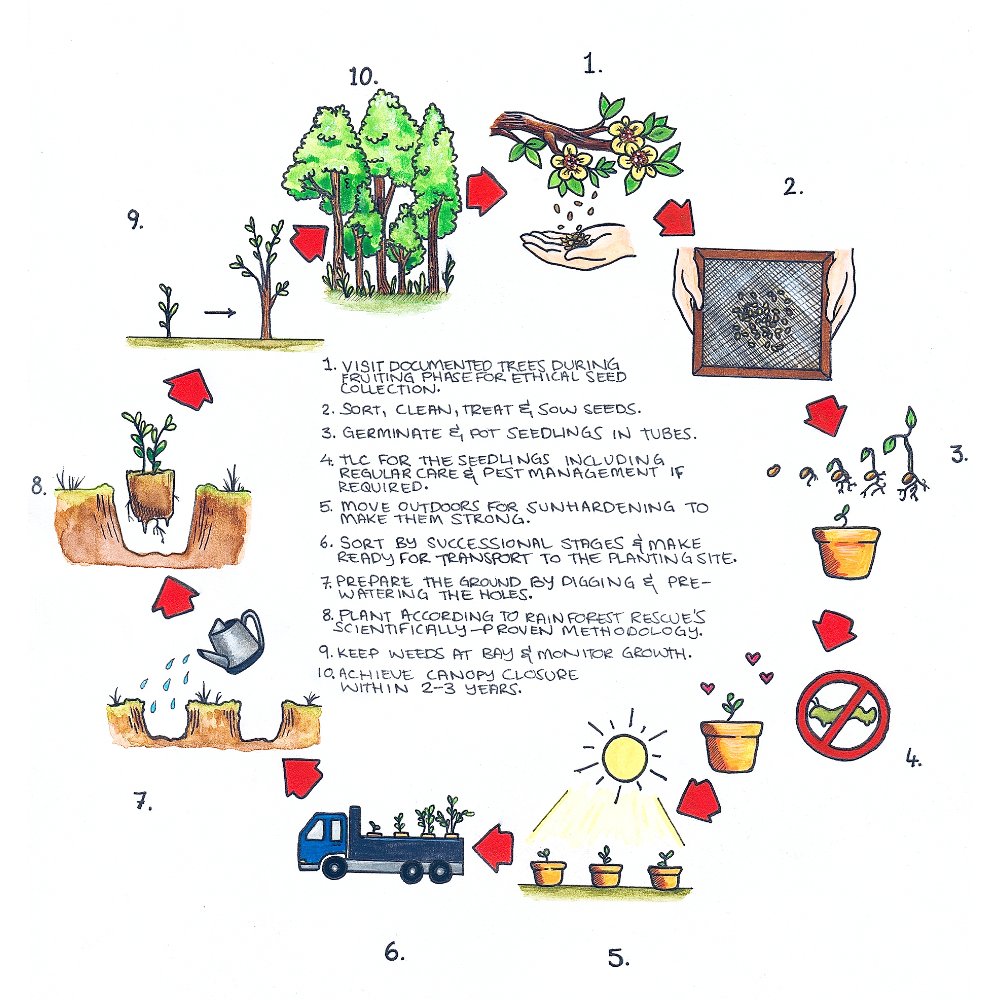
Rainforest Rescue staff collect, propagate and grow the native rainforest trees used across our Daintree lowland ‘Plant a Rainforest’ projects. Seeds are ethically collected from the Daintree Lowland Rainforest between the Daintree River and Cape Tribulation, with the resulting trees planted back into this same landscape.
The original nursery facility, located in Diwan, propagated around 12,000 trees a year. In November 2023, Rainforest Rescue gifted the original Nursery to Eastern Kuku Yalanji Traditional Owners organisation, Jabalbina Yalanji Aboriginal Corporation (JYAC), in support of their propagation and restoration goals to heal country. Read about the nursery handover here.
Our current nursery facility is the Daintree’s largest Native Nursery. Located at the old Cow Bay Airstrip site, it was only possible thanks to your support. At full operation, the nursery will enable us to produce 150,000 trees per year, enough to replant almost 25 hectares of rainforest habitat every year.
Our Planting Methodology
Restoring rainforest is about much more than putting trees in the ground. The species we plant, where we plant them, how closely they are spaced and even what is happening beneath our feet can influence how successfully rainforest returns.
Our former Scientific Advisor, Dr. Robert Kooyman, developed a planting model designed to create rich rainforest in the shortest amount of time, encouraging rapid canopy closure and abundant diversity. Where this model has been used, we have seen excellent outcomes. The method plants up to 8,000 stems per hectare, with trees planted approximately 1.2 metres apart.
Since building the Daintree’s largest Native Nursery at the old Cow Bay Airstrip site, we’ve also been experimenting with two planting methods:
Method 1 is planted out using tree rows 2.6m apart with trees spaced at between 1.8-2m. This will be maintained using a small tractor with a slasher mounted behind.
Method 2 will be twice as dense with rows spaced 1.5-1.6m apart and trees planted on average every 1.7m apart. This will be maintained using a walk behind self propelled Deutscher Slasher.
By comparing the labour required to achieve canopy closure alongside the costs of each approach, we can continue refining how we restore rainforest effectively and efficiently.
But rainforest restoration doesn’t stop at the surface. As Dr. Alex Cheesman, Rainforest Rescue’s Tropical Plant Ecophysiologist and Restoration Advisor points out, healthy soil is fundamental to a resilient rainforest ecosystem. Former agricultural land can have compacted soils, depleted organic matter and altered communities of fungi, microorganisms and invertebrates. As rainforest returns, these complex systems beneath the ground can begin recovering too.
Our restoration methods aim to help create the conditions for that recovery, from carefully selecting native species suited to particular soils to introducing native forest soil during planting and allowing fallen branches and woody debris to remain as habitat.
Dr. Alex has taken a fascinating closer look at soil, and shared how what’s beneath our feet and amongst the roots can have a positive impact on much more than trees. Discover what’s happening beneath the rainforest and why soil regeneration matters to successful restoration.
Why Rainforests?
Rainforests cover only 6% of the Earth’s surface yet contain over 50% of the world’s animal and plant species. They also play a critical role in climate regulation, rainfall and the cycles that sustain life.
Over three-quarters of Australia’s rainforests have been cleared since European settlement. Today, fragments remain across northern Australia and along the east coast to Tasmania.
The Daintree Rainforest is home to an extraordinary array of wildlife, including:
- 30% of Australia’s frog, reptile and marsupial species
- 65% of Australia’s bat and butterfly species
- 18% of all Australian bird species
- around 12,000 insect species
The Daintree region also holds an extraordinary concentration of primitive flowering plant families. Of 19 such families found worldwide, 12 are represented in the Daintree.

DONATE NOW
When you give generously, you become part of a committed team of individuals who collectively are helping to preserve some of the most biodiverse habitats and the species that live within them on this planet. Become a Rainforest Rescuer today!
purchase
and
protect
>>>
and
protect
>>>