Forest Flora – Geosiris australiensis
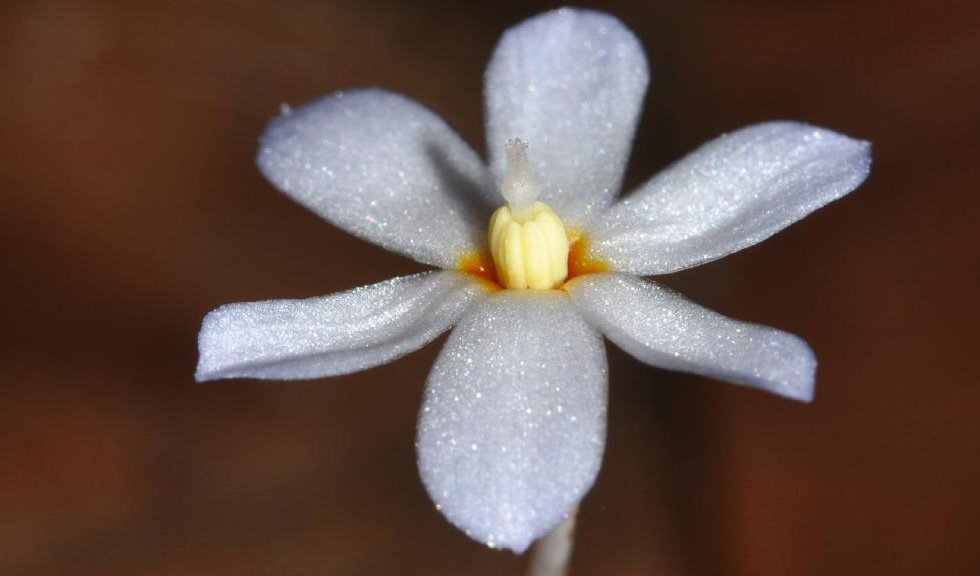 Geosiris australiensis © Tim Hawkes
#ForestFlora – Geosiris australiensis is one of Australia’s most unusual rainforest plants, a tiny, pale herb that quietly defies many of the expectations we have of flowering plants. Discovered in the Daintree Rainforest in 2017, it is endemic to far north Queensland and adds to the growing list of rare and specialised species found in the world’s oldest tropical rainforest.
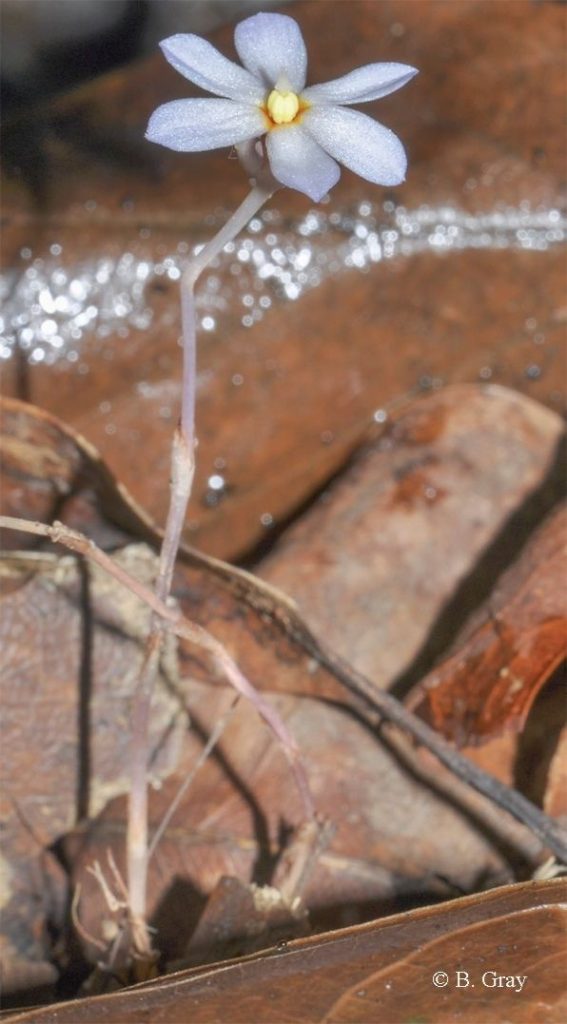
Geosiris australiensis grows on the rainforest floor in deep shade, emerging from the leaf litter as a slender stem only 5 to 12 centimetres tall. For most of its life it remains underground as a rhizome, briefly sending up a white to pale purple flower after the wet season. With no leaves and no green colouring, it is easily overlooked and can be mistaken for a fungal structure rather than a flowering plant.
Unlike most plants, Geosiris australiensis does not photosynthesise. Instead, it is mycoheterotrophic, meaning it relies entirely on fungi to obtain its nutrients. Underground, it connects to fungal networks that are also associated with nearby photosynthesising plants. Through these connections, carbon and nutrients move from green plants, via fungi, to Geosiris, allowing it to survive without sunlight. This unusual lifestyle explains its pale appearance and lack of chlorophyll.
Taxonomically, Geosiris australiensis belongs to the iris family, Iridaceae, a group best known for sun-loving plants such as irises, gladioli and freesias. Within this family, Geosiris is highly unusual. It is the only genus in Iridaceae that has completely lost the ability to photosynthesise, having diverged from its autotrophic relatives around 53 million years ago. Over this time, genes associated with photosynthesis have been lost from its chloroplast genome, while genes required for basic cellular function have been retained.
The discovery of Geosiris australiensis in Australia was significant because, until recently, the genus was thought to be restricted to Madagascar and nearby islands in the western Indian Ocean. Its presence in the Daintree highlights ancient biogeographic connections between Australia, Africa and other Gondwanan landmasses. Scientists suggest that ancestors of Geosiris may have spread during periods when tropical rainforests extended around the Indian Ocean, or possibly through long-distance wind dispersal of its extremely fine, dust-like seeds.
Ecologically, Geosiris australiensis is a reminder of the hidden complexity of rainforest ecosystems. Its survival depends on intact soil fungal communities and healthy surrounding vegetation. While it is small and inconspicuous above ground, it forms part of the intricate below-ground networks that support rainforest life and reflect millions of years of evolutionary change.
Known from only a small number of locations, Geosiris australiensis also highlights how much remains to be discovered in the Wet Tropics. Its existence reinforces the importance of protecting rainforest habitats, not only for large and well-known species, but also for the rare and highly specialised plants that quietly persist beneath the forest canopy.
Fun Facts
- Geosiris australiensis does not contain chlorophyll and never photosynthesises.
- It is one of more than 500 known mycoheterotrophic plant species worldwide.
- The plant spends most of its life underground, only appearing briefly to flower.
- It is the only non-photosynthetic genus in the iris family, Iridaceae.
- Its seeds are extremely small and light, similar to the dust seeds of some orchids.
- The species was discovered by amateur botanists in the Daintree Rainforest.
References
- The Conversation – Geosiris is an early contender for sexiest plant of 2019
- Australian Geographic – Geosiris australiensis: The recently discovered flower of the Daintree
- Atlas of Living Australia
- Australian Tropical Herbarium
- Queensland Herbarium
- Images courtesy of Tim Hawkes and B. Gray
Want more good Rainforest news in your life?
Subscribe to our eNews | Follow us on Instagram | Like us on Facebook | Subscribe to our YouTube channel
Help Protect Rainforests Forever
Donate to Protect Rainforests Forever | Become a Rainforest Guardian | Partnership Options