Critter Corner – Spectacled Flying Fox
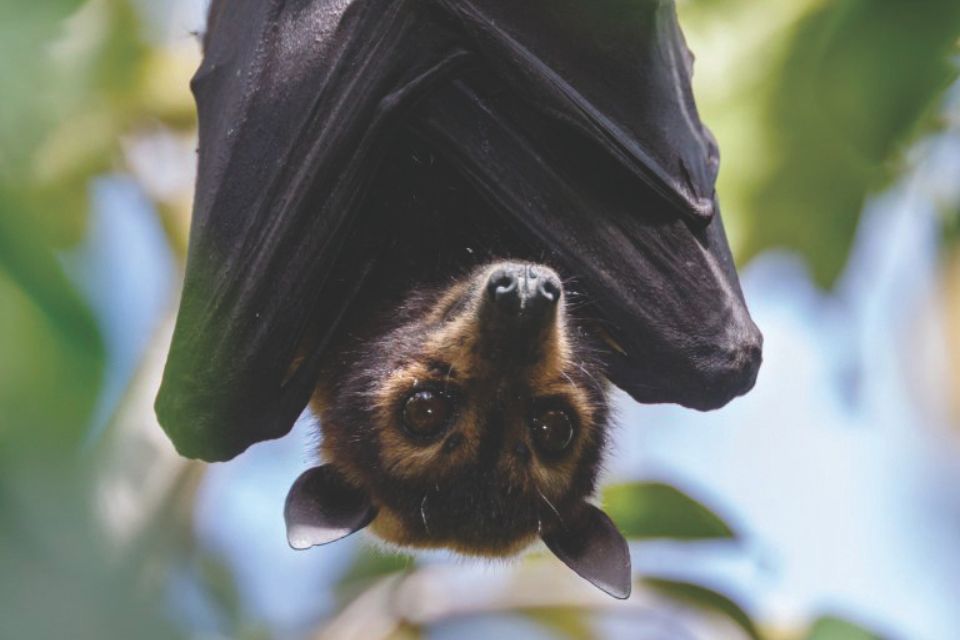 Spectacled flying fox (Pteropus conspicillatus) Credit: Kazredracer (Flickr)
#CritterCorner – With wingspans reaching up to 1.6 metres and distinctive pale rings around their eyes, Spectacled Flying-foxes are one of the most recognisable animals of Far North Queensland. But beyond their striking appearance, these remarkable bats play a vital role in keeping rainforests healthy.
The Spectacled Flying-fox (Pteropus conspicillatus) belongs to the megabat family, a group of fruit bats found throughout the tropics. Their common name comes from the pale, straw-coloured fur around their eyes that resembles a pair of spectacles.
These bats have fox-like faces, large eyes and excellent vision and sense of smell, which they rely on to locate food at night. Unlike many smaller bats, flying-foxes do not use echolocation. Instead, they navigate and forage using their keen eyesight and strong sense of smell.
Males typically weigh between 580 and 850 grams, while females are slightly smaller, weighing around 500 to 650 grams. With wingspans reaching up to 1.6 metres, they are among Australia’s largest bats.
Spectacled Flying-foxes feed mainly on fruit, nectar and pollen from native rainforest trees. As they move between feeding sites each night, they carry pollen from flower to flower and disperse seeds across the landscape.
This makes them essential to rainforest regeneration. Much like cassowaries are often described as rainforest gardeners for spreading seeds along the forest floor, flying-foxes help forests grow and recover by distributing seeds over long distances and pollinating flowering trees.
In Australia, the Spectacled Flying-fox occurs mainly in the Wet Tropics of north-eastern Queensland, where the largest population is found between Townsville and Cooktown. The species also occurs in Papua New Guinea, Indonesia and the Solomon Islands.
During the day they gather in communal camps, roosting high in the canopy of tall trees in rainforest, mangroves and swamp forests. At dusk, thousands may leave these camps to forage across the landscape, travelling many kilometres each night in search of flowering and fruiting trees.
Today the Spectacled Flying-fox is listed as Endangered under Australia’s national environmental legislation.
Major threats include habitat loss, disturbance of roosting camps, entanglement in netting or barbed wire, collisions with vehicles and powerlines, and tick paralysis. Climate change is also emerging as a serious pressure on the species.
In 2018, an extreme heatwave in north Queensland caused a mass die-off of spectacled flying-foxes, with an estimated 23,000 animals dying during a single event.
Protecting rainforest habitat and safe roosting sites is essential for the survival of this important species – and for the forests that depend on them.
Fun Facts About Spectacled Flying-foxes
- A Bat with Spectacles: The pale fur around their eyes gives them their distinctive name.
- Big Wings: Their wingspan can reach up to 1.6 metres.
- Night-time Gardeners: They pollinate flowers and disperse seeds across large distances.
- One Pup a Year: Females usually give birth to a single pup annually.
- Sharp Senses: Flying-foxes rely on vision and smell rather than echolocation to find food.
References
- Australian Government Department of Climate Change, Energy, the Environment and Water
- National Recovery Plan for the Spectacled Flying-fox (Pteropus conspicillatus)
- Queensland Government – Importance of Flying-foxes
- James Cook University – Pteropus conspicillatus species information
Want more good Rainforest news in your life?
Subscribe to our eNews | Follow us on Instagram | Like us on Facebook | Subscribe to our YouTube channel
Help Protect Rainforests Forever
Donate to Protect Rainforests Forever | Become a Rainforest Guardian for as little as $2 a month | Partnership Options