Seeing the forest grow: how lasers are transforming rainforest restoration
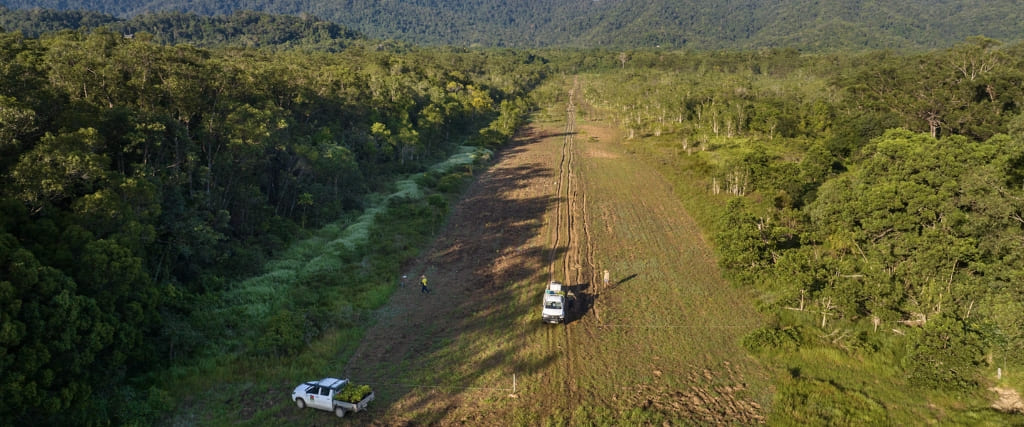 Proving the long-term impact of rainforest restoration is as vital as doing the hard work itself! © Martin Stringer
Restoring a rainforest is a long-term commitment. Trees can take decades to grow, ecosystems take time to recover, and the benefits of restoration—carbon storage, wildlife habitat, and a landscape’s resilience to climate change—are not always easy to measure.
One of the biggest challenges in restoration is proving that what we are doing is working, and doing so in a way that is transparent, credible, and useful for improving future practice.
This is where lasers come in.
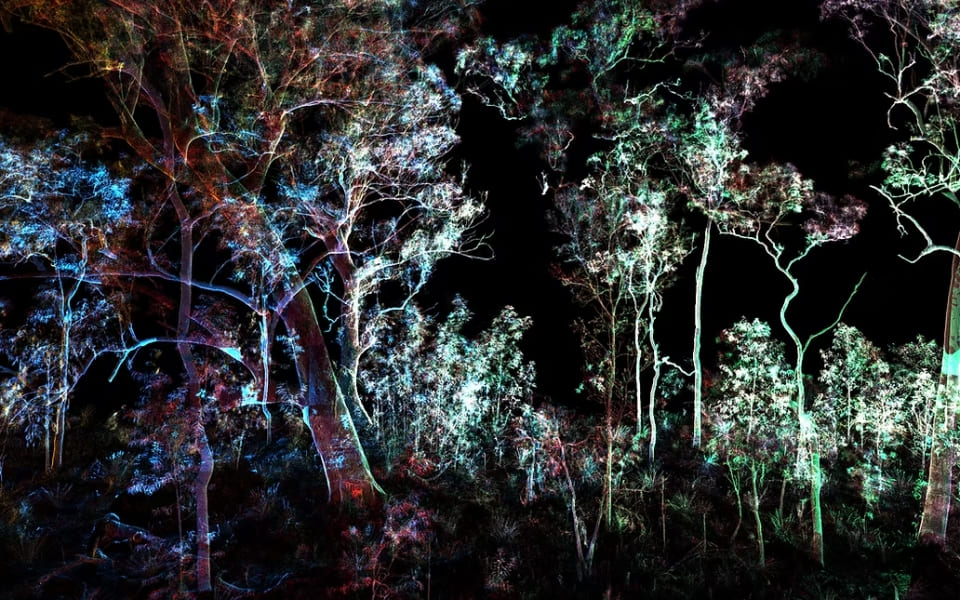 LiDAR scanning forest habitat © ArborMeta
Seeing the rainforest like never before
Over the past few years, Rainforest Rescue has been working with researchers like Dr Alex Cheesman at James Cook University’s Centre for Tropical Environmental and Sustainability Science and technology partners at ArborMeta to use ground-based laser scanning—sometimes called LiDAR—to measure and track the recovery of restored forests. These instruments emit millions of tiny laser pulses that bounce off tree trunks, branches, and leaves, creating a detailed three-dimensional map of the forest. The result is a precise digital snapshot of forest structure that can be revisited again and again through time.
Unlike traditional field surveys, which rely on measuring the height and diameter of a relatively small number of trees by hand, laser scanning captures the whole forest. Every stem, every branch, and the shape of the canopy are recorded. From this information, scientists can directly calculate how much wood—and therefore carbon—is stored in a regenerating forest, and how quickly that storage is increasing as trees grow.
For Rainforest Rescue, this technology offers two powerful advantages. First, it provides clear, visual evidence of restoration success. Laser scans allow us to literally see forests becoming taller, denser, and more structurally complex over time. This will make it much easier to communicate outcomes to supporters, partners, and investors, and to demonstrate that restoration activities are delivering real, measurable benefits.
Second, these data help improve restoration practice itself. By comparing scans across different sites and planting strategies, Rainforest Rescue hopes to identify which approaches lead to faster growth, higher carbon uptake, or more complex forest structure. This feedback loop (measure, learn, adapt) is essential for scaling up restoration in a cost-effective and ecologically meaningful way.
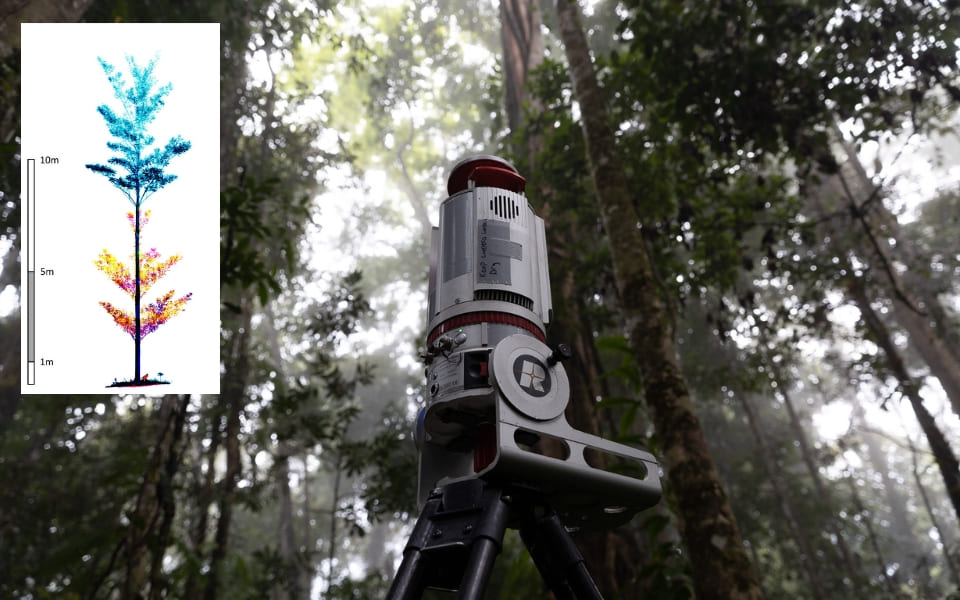 LiDAR scans provide the ability to measure trees (like this young Elaeocarpus grandis at two different intervals, inset) to gauge carbon and biodiversity accounting outcomes. © ArborMeta & Dr Alex Cheesman
Innovating rainforest research methodologies
Importantly, Rainforest Rescue is not just using these tools; it is helping to develop them. The organisation is a key partner in a current Australian Research Council (ARC) funding application aimed at expanding the use of laser scanning in forest restoration. This project seeks to refine how lasers are used to measure young, regenerating forests, and to integrate these measurements with broader carbon and biodiversity accounting frameworks. By being involved from the ground up, Rainforest Rescue is helping ensure that new methods are practical, robust, and directly relevant to the real world.
As interest grows in carbon and biodiversity markets, the need for trustworthy, science-based measurement is greater than ever. Laser scanning offers a way to move beyond estimates and assumptions, toward direct, repeatable evidence of ecosystem recovery.
By being involved in the early development of these technologies, Rainforest Rescue is helping set a new standard for transparency and best practice in rainforest restoration—one that ensures every tree planted, and every forest restored, truly counts.
Authored by Dr Alex Cheesman, Rainforest Rescue’s Tropical Plant Ecophysiologist and Restoration Advisor. For more information, view the academic paper associated with this piece or contact Dr Alex Cheesman.
Cheesman et al 2026. The role of ground-based laser scanning in quantifying and crediting tropical forest restoration: An Australian case study. Ecological Solutions and Evidence (in press)
Want more good Rainforest news in your life?
Subscribe to our eNews | Follow us on Instagram | Like us on Facebook | Subscribe to our YouTube channel
Help Protect Rainforests Forever
Donate to Protect Rainforests Forever | Become a Rainforest Guardian | Partnership Options