Is this really the world’s most dangerous bird?
The southern cassowary is often labelled the “world’s most dangerous bird,” but this reputation obscures a deeper truth. Southern cassowary conservation is not about fear — it’s about understanding, coexistence, and protecting one of the rainforest’s most vital keystone species.
In this National Geographic feature, conservationists, scientists and cultural storytellers unpack how rare human encounters shaped the cassowary’s fearsome image, while habitat loss, road strikes and fragmentation now pose the real danger. The article includes insights from Allen Sheather, Rainforest Rescue’s Daintree Ecological Advisor, whose decades of experience working alongside cassowaries offers a grounded, compassionate perspective on these extraordinary birds.
Originally published by National Geographic on 2 January 2026, the article below is reproduced here unedited, with full credit to the original author and publication.
|
Rare attacks helped brand the cassowary as deadly, but habitat loss and human activity now pose a far greater threat to the bird’s survival.By Olivia Ferrari
|
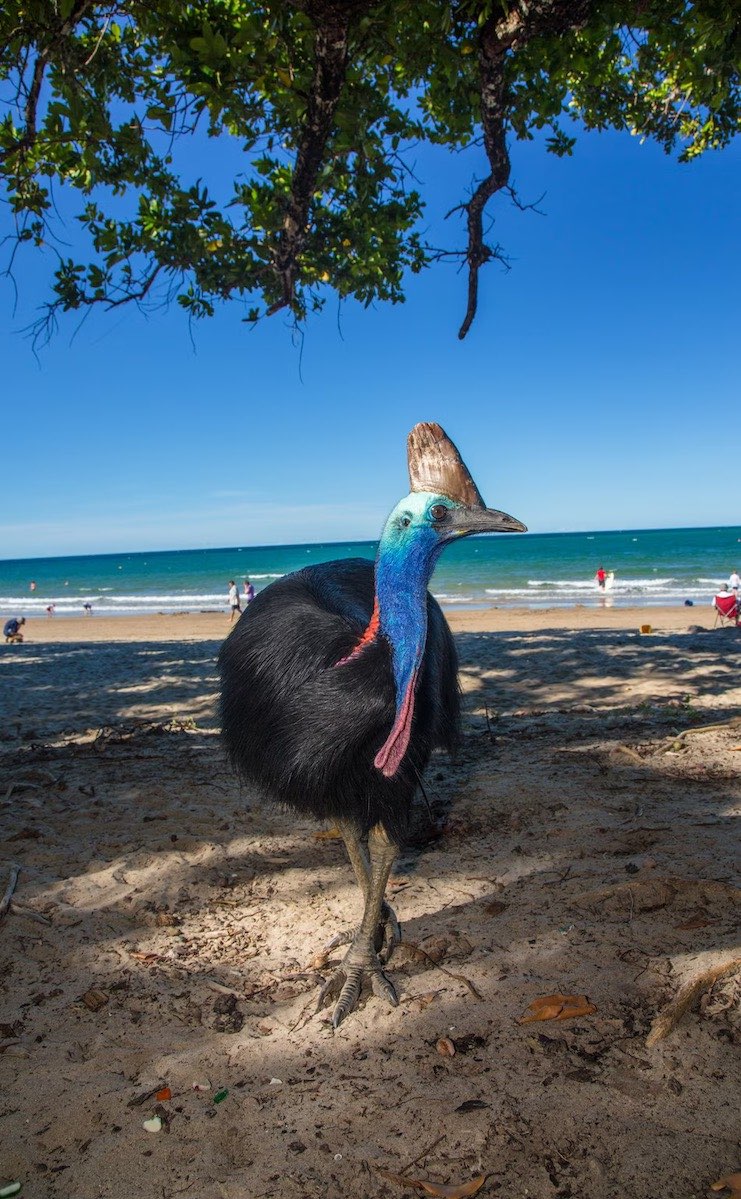
Towering at five and a half feet tall, sprinting up to 31 miles per hour, and leaping up to seven feet off the ground, cassowaries are the stuff of legends. They are the third largest bird in the world, weighing up to 175 pounds with sharp talons that grow up to five inches long. Their powerful kick, which defends them from predators, can break bones, damage internal organs, and even be lethal.
“These birds look like an intimidating cross between a velociraptor, an emu, and a giant turkey,” says children’s book author Beverley McWilliams, who wrote the book Cassowary Dad.
The two recorded human deaths related to this creature have earned it the title of “world’s most dangerous bird” in the Guinness Book of World Records.
But scientists say these striking birds are misunderstood, and focusing on their potential to be aggressive overshadows how important they are to science, history, and ecosystems.
For one, cassowaries, like most modern birds, are direct descendants of theropod dinosaurs. The helmet-like casque on a cassowary’s head is one of its most dinosaur-like features. Observing these birds can work like a time machine, helping paleontologists imagine how extinct dinosaurs might have behaved, says Todd Green, paleontologist at the New York Institute of Technology.
The majestic cassowary has long been important to indigenous communities, found in up to nine-thousand-year-old artifacts. And these birds keep their entire forest ecosystems across Oceania running by dispersing seeds.
Cassowaries aren’t naturally aggressive, experts say, regardless of how their anatomy might make them seem scary.
Here’s how cassowaries got such a bad reputation, and why conservationists are worried it may affect the species’ future.
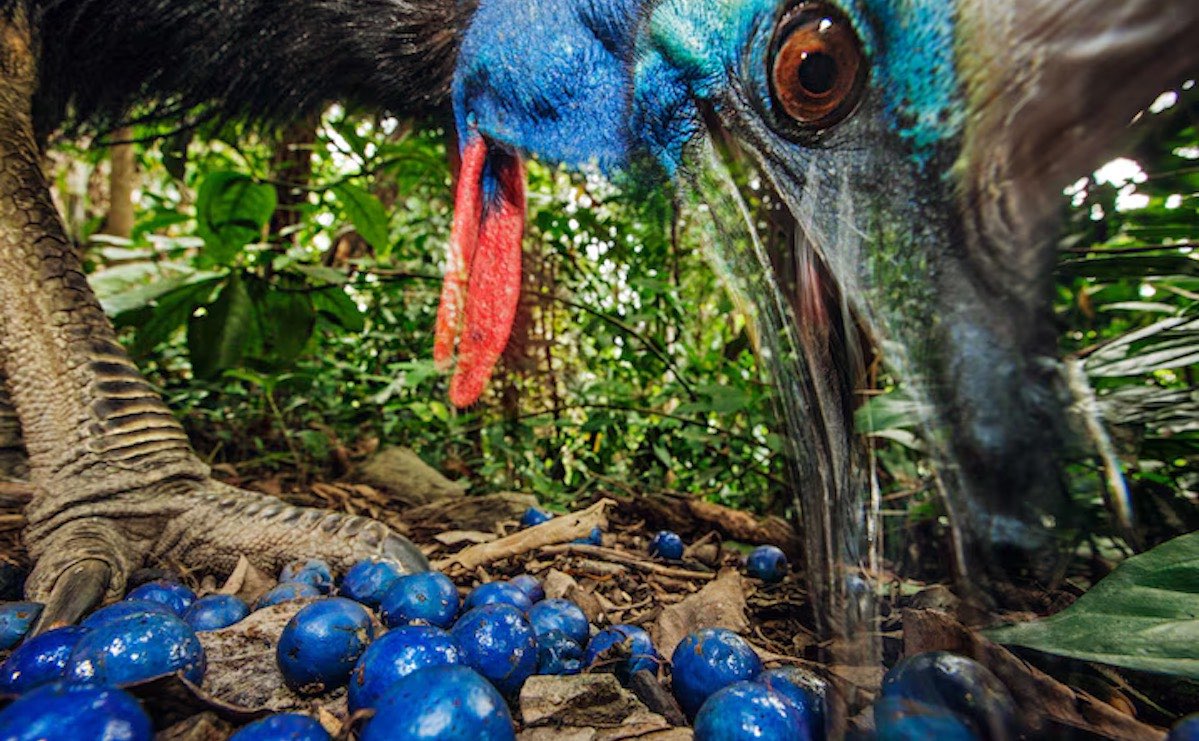
A male cassowary feasts on blue quandongs, a favorite fruit of the species.
CHRISTIAN ZIEGLER, NAT GEO IMAGE COLLECTION
How cassowaries got a bad rap
Allen Sheather of Rainforest Rescue’s Cassowary Recovery Team has had plenty of run-ins with cassowaries, and after over 30 years working with the enormous birds, he thinks we’ve got them all wrong.
A cassowary once approached Sheather while he was crouched down, working on his house in Australia. “I only noticed her when her feet were directly in front of me,” recounts Sheather. “It is quite daunting to see a cassowary looking up from low down.”
But the bird just watched him, picked up some fruits near him, and walked away. They’re very curious birds, says Sheather, which can be misinterpreted as aggression. During World War II, reportedly American and Australian troops stationed in New Guinea were warned to steer clear of the large birds.
So why did these curious birds come to be named the most dangerous in the world?
Cassowaries have killed two people in recorded history: an Australian teenager was killed in 1926 after hitting a cassowary with a bat, and a man in Florida was killed in 2019 by a cassowary he kept in captivity, bringing the world’s attention to the formidable birds.
A study of 150 reported cassowary attacks on humans in Queensland, Australia, found in most cases the birds attacked while defending food, their chicks, or eggs, or when cornered. In 75 percent of cases people had previously fed the birds. “These cassowaries associate people with food, and this can change their naturally shy behavior,” explains McWilliams, “resulting in them chasing people and cars or approaching houses with the expectation of being fed.”
Crocodiles kill about a thousand people a year, and hippos kill about 500 people a year, compared to cassowaries’ two recorded fatalities since 1926. “They have the equipment to cause a lot of damage,” says Green, “but if you’re respecting them and respecting their space, it’s very unlikely to be an issue.”
In fact, these birds also have a unique family dynamic, as fathers are often involved in raising offspring. The relationship between cassowary males and their chicks inspired McWilliams’ children’s book Cassowary Dad. Among these birds, it’s the father who incubates the eggs, and is frequently the only parent caring for chicks. McWilliams explains that during egg incubation the father will barely leave the nest, and after hatching he spends up to 18 months with the chicks. “Cassowaries are protective and proactive fathers,” says McWilliams. “They are arguably nature’s most devoted dads.”
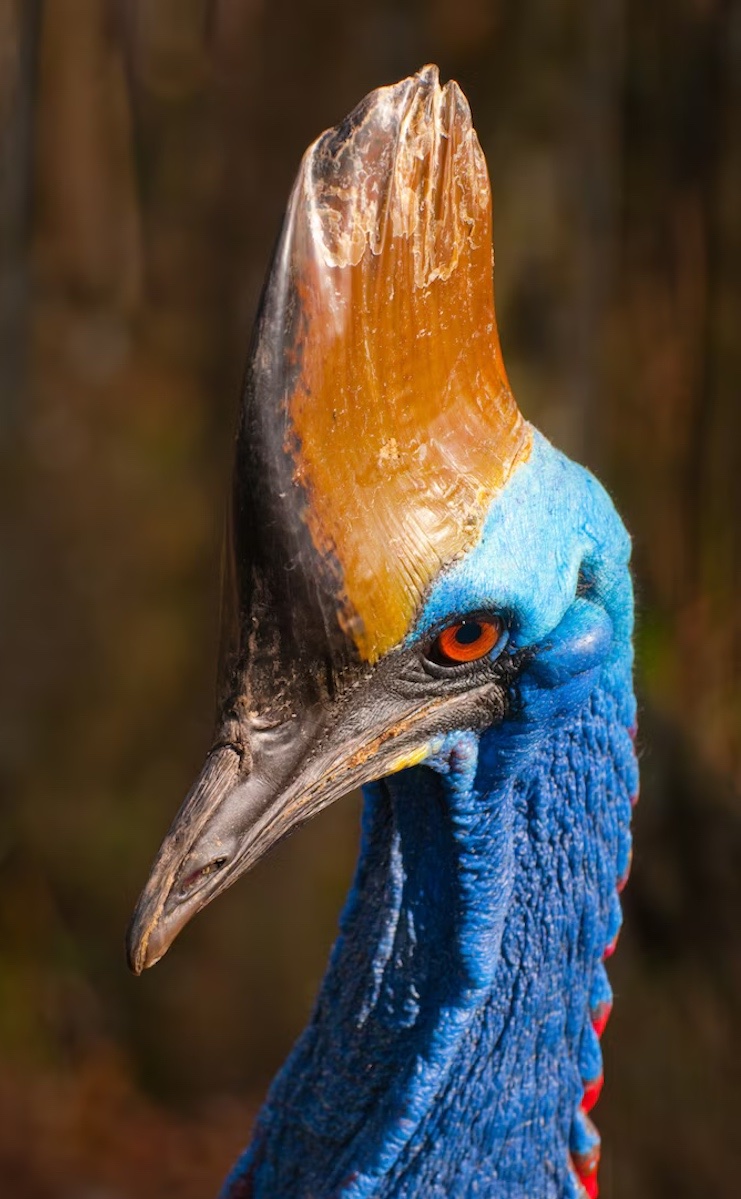
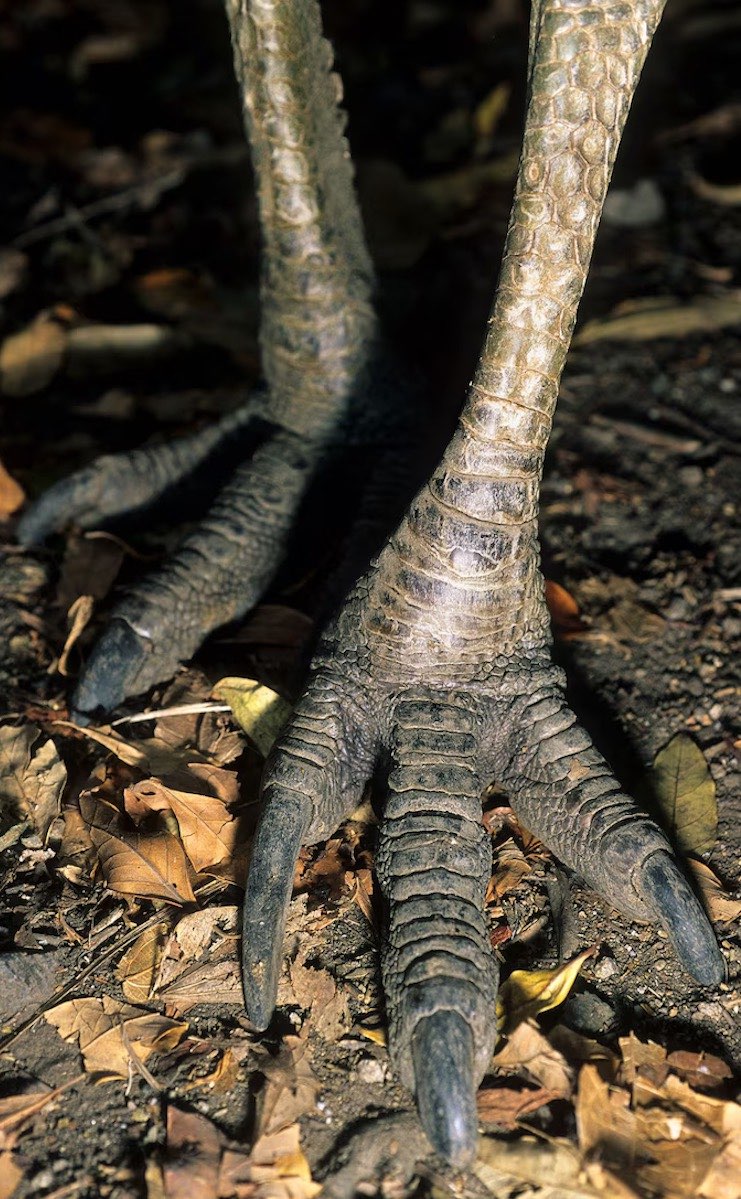
Left: A southern cassowary at White Oak Conservation Center in Nassau County, Florida.
FANS LANTING, NAT GEO IMAGE COLLECTION
Right: This close up shot shows the feet of a southern cassowary.
ROLAND SEITRE, NATURE PICTURE LIBRARY
Cassowaries as the heroes of their ecosystems
Cassowaries haven’t always been so maligned. Their otherworldly presence is featured extensively in mythology from indigenous groups of New Guinea, often as the hero of the story. As birds that walk on two feet rather than fly, they are described as creatures halfway between the human and animal worlds: in one creation myth cassowaries even transformed into the world’s first humans. The cassowary is part of traditional songs and ceremonies, and they have been a treasured source of meat, bones, and feathers for ritual ornaments.
Along with their cultural significance, cassowaries are also vital to rainforest ecosystems. They are considered a keystone species, eating fruit whole and spreading seeds through their droppings over long distances, encouraging new plants to grow in their path.
Some plants practically rely on the birds for fertilization. Ryparosa kurrangii, a rare tree in Queensland tropical rainforests, has a symbiotic relationship with cassowaries, only sprouting about four percent of the time when planted without the help of the bird. However when the seeds first passed through a cassowary’s gut, they germinated 92 percent of the time allowing this tree to survive.
Cassowaries also give researchers a look into the Mesozoic Era. Cassowaries serve as living models for dinosaur features, offering paleontologists clues to dinosaur senses, feather structure, and mobility.
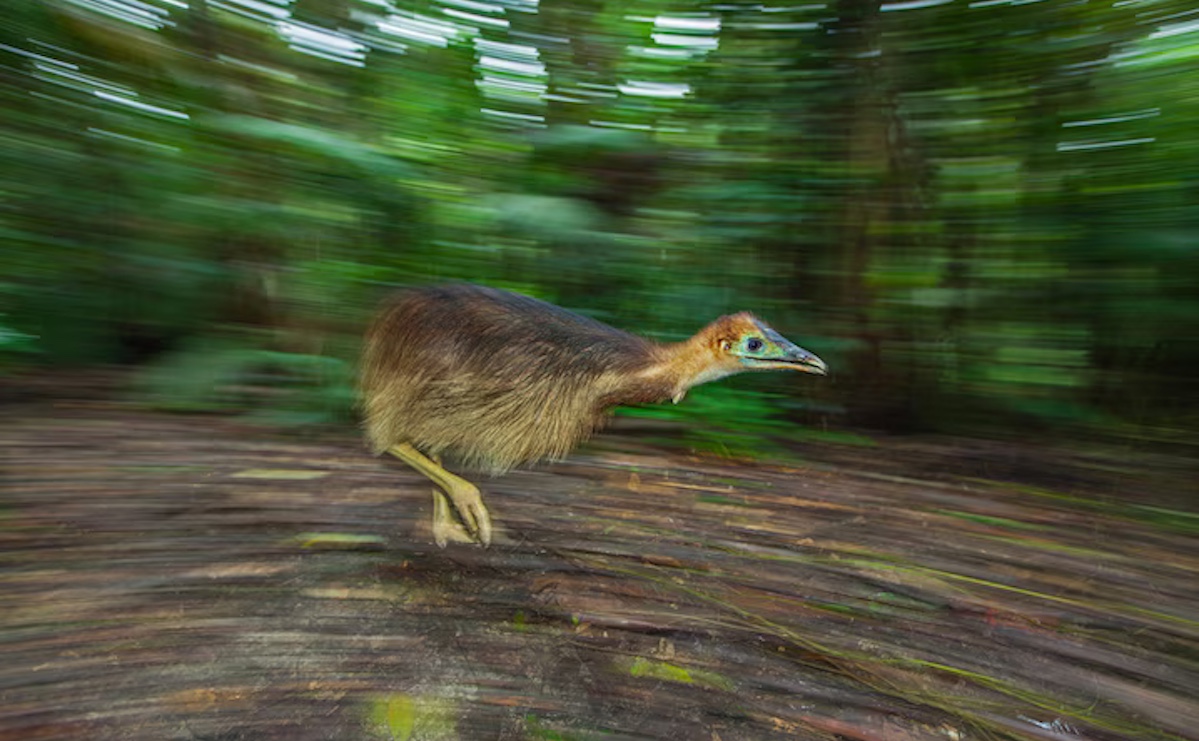
A cassowary chick runs to find a fruit it heard dropping to the ground.
Cassowary chicks eat a mix of fallen fruits, insects, and small invertebrates.
CHRISTIAN ZIEGLER, NAT GEO IMAGE COLLECTION
Conservation and coexistence
Despite their image, humans are a bigger threat to cassowaries than they are to us. Southern cassowaries are now endangered in Australia, with less than 5,000 left in the wild, threatened by habitat loss, car strikes, and dog attacks. Since cassowaries are slow to reach breeding age, and can live up to 50 years, each cassowary lost has a major impact on the population.
“Portraying cassowaries as simply dangerous and aggressive is unfair and potentially harmful to an animal that needs our protection,” says McWilliams.
The Queensland government has implemented better road signage to avoid collisions with cassowaries, and education programs for dog owners. Meanwhile, nonprofits like Rainforest Rescue are working to restore and reconnect rainforest fragments to improve habitat.
(Read how this bird plays a central role in shaping the rainforest.)
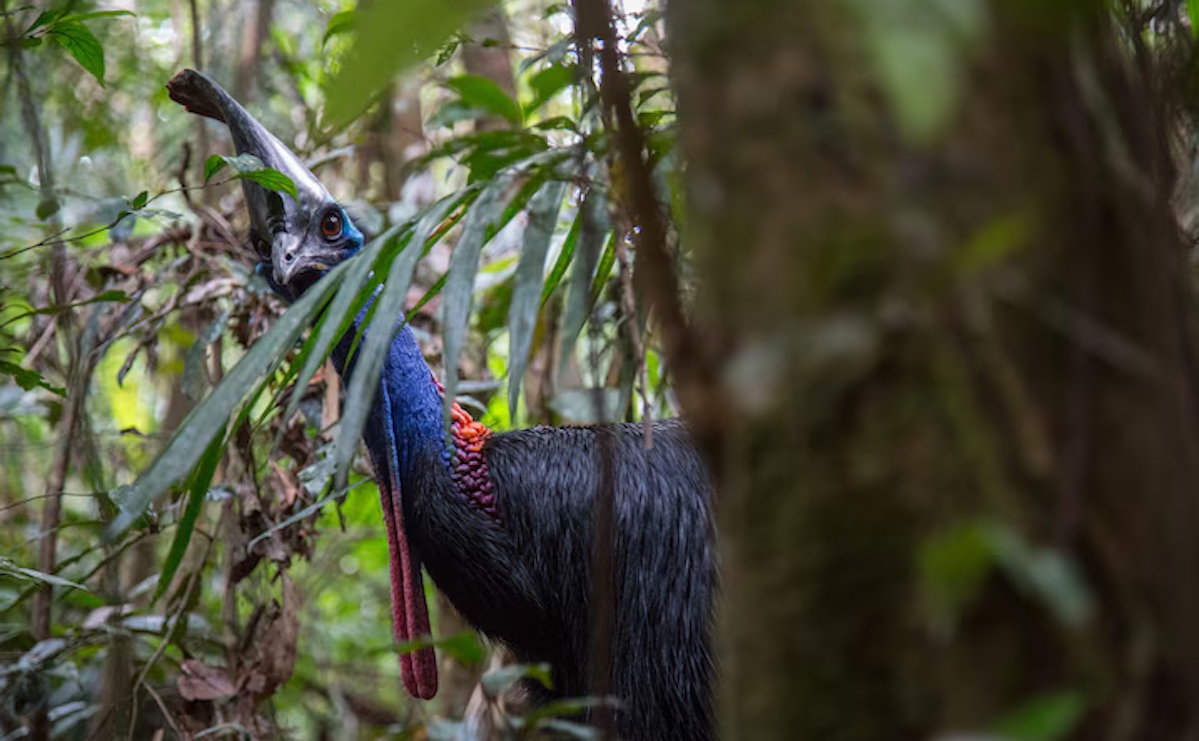
A southern cassowary stands in the foliage of the Wet Tropics of Queensland.
UNESCO’s World Heritage Convention recognizes this area for its extensive and varied array of plants,
as well as rare and endangered animals and plant species.
CHRISTIAN ZIEGLER, NAT GEO IMAGE COLLECTION
“One thing I am particularly proud of is that through the work of the Cassowary Recovery Team we have been able to stabilize the existing population,” says Sheather. Other Australian environmental groups like the Community for Coastal and Cassowary Conservation and Kuranda Conservation focus on local education, land restoration like tree planting, and rehabilitating injured cassowaries.
You might be intimidated to be face-to-face with one of these impressive birds, but conserving them is crucial—and they command respect. Although Green has spent years in the presence of cassowaries in captivity and in the wild, he says their curiosity, intelligence, and striking presence never gets old.
“It’s something I will never get used to, and I will never stop appreciating,” says Green. “These birds are just absolutely magnificent.”

.
At Rainforest Rescue, southern cassowary conservation is inseparable from rainforest protection. Cassowaries depend on large, connected tracts of lowland and upland rainforest — the same landscapes that have been most heavily cleared, fragmented, or degraded over the past century.
Through land purchase and protection, habitat restoration, and the reconnection of wildlife corridors across the Daintree, Rainforest Rescue works to ensure cassowaries can move safely through their landscape, disperse seeds, and continue shaping rainforest ecosystems as they have for millions of years.
By shifting the narrative from fear to respect, and from isolation to connectivity, we can help secure a future where cassowaries — and the rainforests they sustain — continue to thrive.
This article was originally published by National Geographic and written by Olivia Ferrari. It is shared here to highlight the role of Rainforest Rescue and the importance of southern cassowary conservation in the Daintree Rainforest.
Want more good Rainforest news in your life?
Subscribe to our eNews | Follow us on Instagram | Like us on Facebook | Subscribe to our YouTube channel
Help Protect Rainforests Forever
Donate to Protect Rainforests Forever | Become a Rainforest Guardian | Partnership Options